
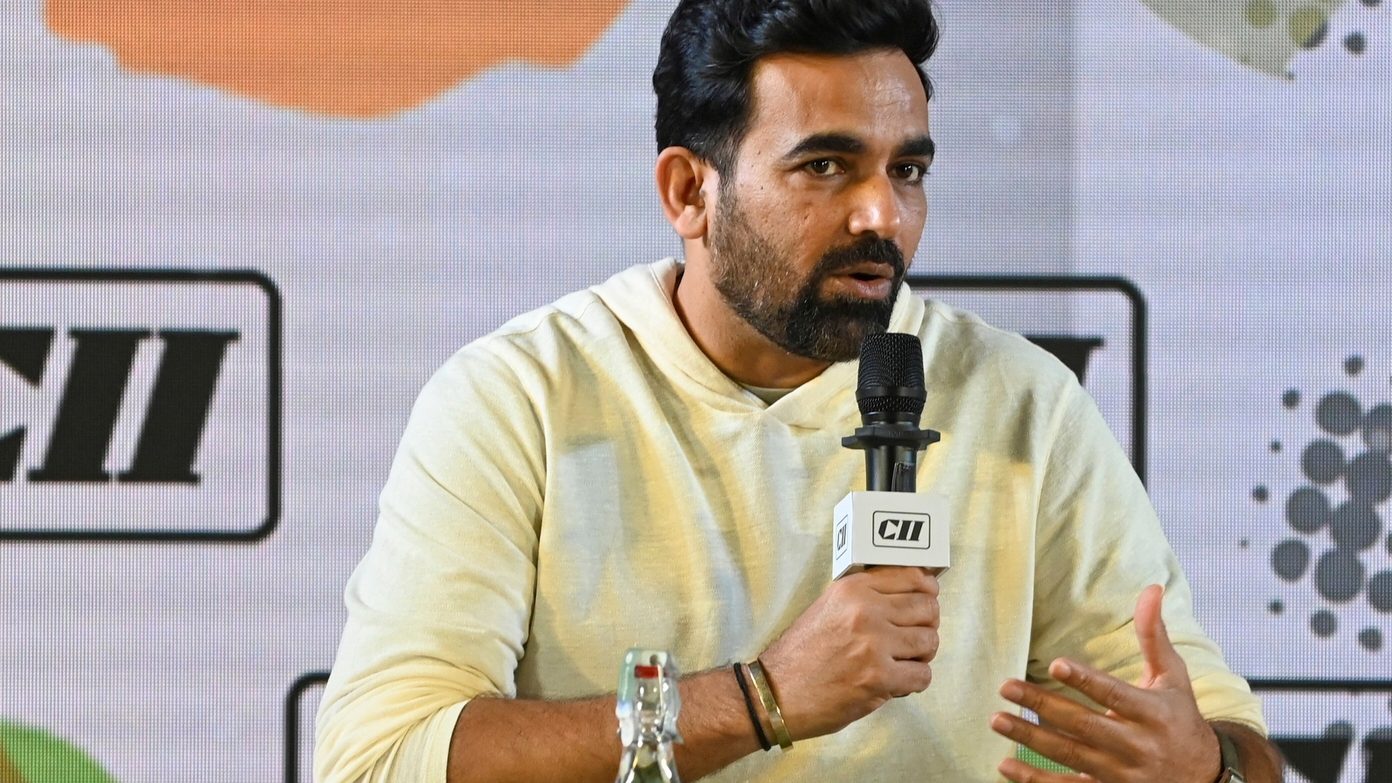
New Delhi: Imagine Deepti Sharma bowling to Glenn Phillips, or Smriti Mandhana taking strike against Nandre Burger. For the longest time, the concept of men and women competing in the same professional cricket match seemed like a distant dream. But thanks to one of India’s finest cricketers, it may be closer than you think.
If all goes to plan for Zaheer Khan, the first-ever top-flight cricket league featuring men and women playing in the same match could get underway in Germany by August next year. (PTI)
Zaheer Khan, one of the country’s great left-arm pacers, is giving wings to this idea. If all goes to plan, the first-ever top-flight cricket league featuring men and women playing in the same match could get underway in Germany by August next year.
Project Equal, a mixed-gender T20 franchise league being developed in association with the German Cricket Federation, is Zaheer’s brainchild. Inter-gender competition isn’t a new model. Men and women had faced off in tennis before but the label ‘Battle of the Sexes’ stuck in 1973. Bobby Riggs beat Margaret Court in the ‘Mother’s Day Massacre’ before losing to Billie Jean King in Houston. King’s win was a landmark moment for women’s sport and the fight for equal pay.
Subsequent duels under the same banner were largely exhibition matches. Jimmy Connors beat Martina Navratilova in 1992 at Caesars Palace in Las Vegas, under handicap rules. In 1998, Karsten Braasch, then ranked 203rd, beat both Williams sisters in separate one-set matches at the Australian Open. The latest edition of the ‘Battle of the Sexes’ took place in December last year, when Nick Kyrgios beat the then WTA world No.1 Aryna Sabalenka in Dubai. The match drew considerable criticism.
In cricket, however, the thought remained an anomaly. With the popularity of women’s cricket continuing to grow with every passing tournament, Zaheer is eager to explore the possibility of bringing both genders together on the same field, competing alongside and against each other.
“In tennis, mixed-gender matches are interesting. Cricket, meanwhile, is evolving, and women’s cricket has been growing very popular. The women’s game is progressing very well, and I think this initiative will add to that growth as well. Generally, when you look at the cricket ecosystem, you want growth to happen in every direction. We felt this could generate more interest in the game,” Zaheer told HT.
“Also, this is something that hasn’t been tried before. Many sports have mixed-gender competitions, but cricket is one of the few where this format hasn’t really taken off.”
Zaheer optimistic despite challenges
All that, however, is easier said than done. Plenty of questions need to be addressed to ensure smooth execution. For starters, given the difference in the physical attributes of male and female cricketers, what should the field dimensions be? Will the boundary ropes be shorter? How will the difference in power-hitting impact performances? Surely, certain rules will have to be different for men and women. With eight months to go, Zaheer has plenty to figure out. But no obstacle, however big, appears capable of standing in the way of his vision.
“We will be looking into that in depth to strike a balance. But, to give you an example, in Indian women’s cricket, there are plenty of stories of women who grew up playing cricket with boys. So, this has been happening, just not in the most structured way. That’s what we are here for.”
Besides his baby, Zaheer, the newly appointed head coach of IPL franchise Chennai Super Kings, has another ambitious project in the works. Earlier this year, the European T20 Premier League was launched to much fanfare, and Zaheer believes Europe holds tremendous untapped potential for cricket, given the sport’s scope for growth in emerging markets across the continent. Through Anchor Sports, which he is spearheading alongside two business partners, Zaheer hopes to strengthen the grassroots cricket ecosystem in the region and help produce the next generation of cricketing heroes. Italy and the Netherlands making their mark on the T20 World Cup stage recently has only reinforced that belief.
“I feel cricket is ever so evolving and reaching out to places where no one has really thought about, isn’t it? ICC has been running the cricket development programme in many countries. And, you know, that’s the whole effort,” said Zaheer.
“I feel that the time is right, right now, in terms of the expansion of the game. It’s very exciting that we are actually able to contribute or set plans in motion with regard to that. Cricket is going to be soon inducted in the Olympics as well. And I think that’s going to be a big step forward in the right direction.”
For Faisal Shariff, CEO of Anchor Sports, the vision couldn’t be clearer. They don’t want to compete with IPL, a mistake several leagues have made and paid the price for. Instead, player welfare remains the top priority. Zaheer, co-owner of Lanka Premier League franchise Jaffna Kings, experienced a setback when Sri Lanka Cricket terminated the franchise’s contract with fellow owner Manjot Kalra. That’s not all. For years, players of the Bangladesh Premier League have complained about payment delays, defaults and unpaid salaries. Ensuring none of that happens again is key priority.
“In fact, I can give you an example of when Jaffna happened. There was that little incident where they had to remove the owner of the Jaffna team. The first thing we asked Zak when we spoke to him was whether the players had been paid. We had to make sure that they didn’t lose any money and that they were taken care of,” Shariff told HT.
“And that really showed a side of Zak that reflects how much he cares and how focused he is on the right things. Instead of asking about anything else, such as the price or the business proposition, he wasn’t interested in that.”
The promise begins at the grassroots level. It starts with building and developing players through academies and infrastructure. The venture built the first indoor facility in Stockholm, where temperatures can dip to minus one degree Celsius and snowfall is common during winter. There is no way cricket can be played outdoors in the country at this time of the year. Hence, setting up a facility where people can train throughout the winter was an important part of its plans to strengthen the infrastructure and provide quality coaching.
“How does one build local fan bases in all these countries? They can’t just take cricket as a product. We need to have entertainment alongside cricket, and we need to introduce the sport to these people. So, how do we go about it? By getting into schools. We actually organised the first Schools Cup in Stockholm about six months ago,” founder Nagendra Siddoutam told HT.
“That was the first time six schools came together and played in an indoor league. That’s the kind of development we want to drive. If you have a league here in Sweden tomorrow, for example, you can see these kids coming to watch the game. They’ll bring their families, and that’s how we can grow the sport. So, that’s the building part of the ecosystem in countries where cricket is not a mainstream sport.”