
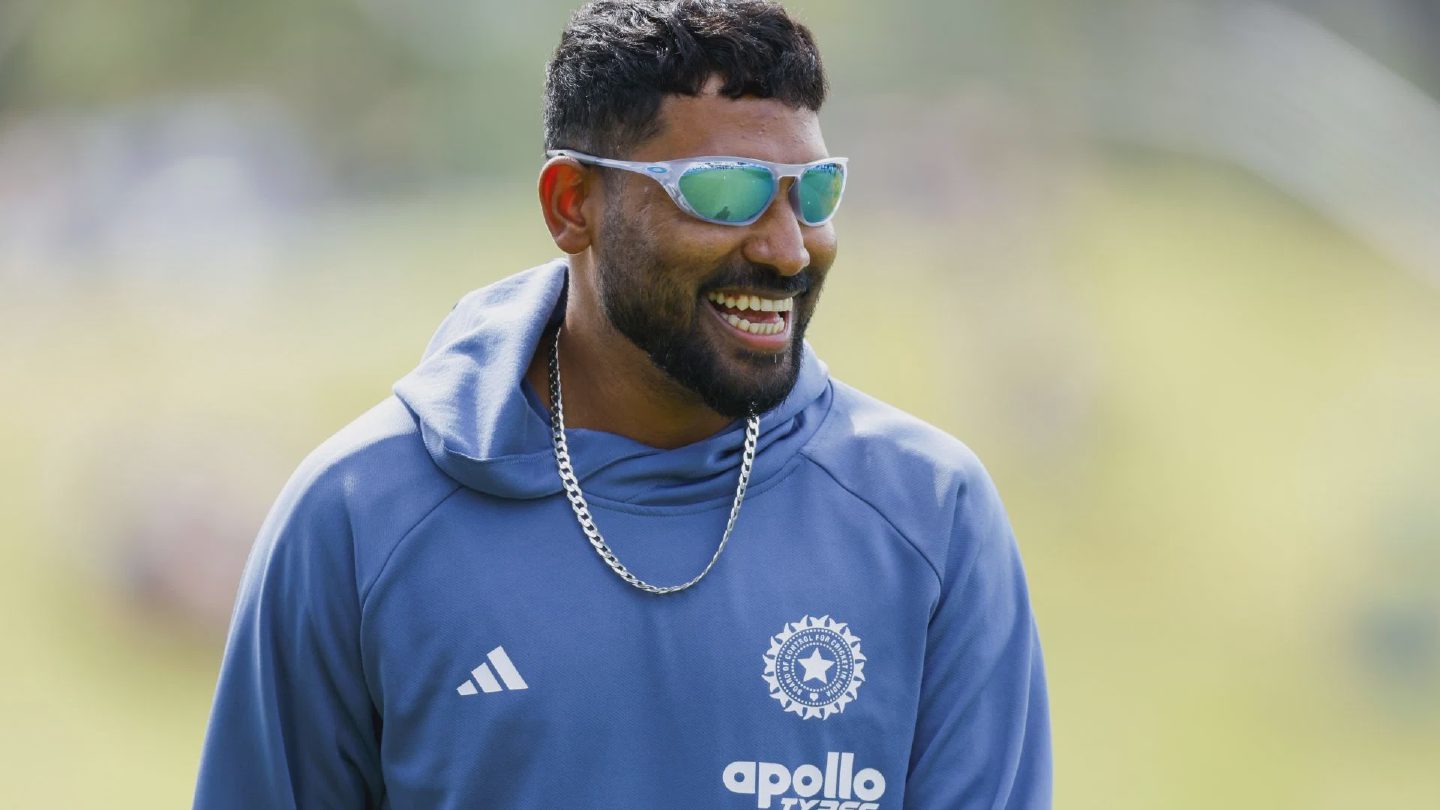
The drinks tray does not rattle when Mohammed Siraj carries it across the outfield at Hagley Oval, yet the sight of him in a bright bib feels noisier than any spell he has bowled in a long time.
At 32, the man who spent six years as India’s red-ball battering ram has been reduced to ferrying hydration and tactical whispers to younger quicks in Christchurch, watching a two-Test series in New Zealand pass him by without a single delivery bowled in whites.
When Shubman Gill confirmed before the opening Test in Wellington that Siraj had been left out on “current form”, it sounded tidy, clinical, and modern. Yet to anyone who watched Henry Nicholls and Glenn Phillips bat New Zealand out of a 70-for-5 hole at the Basin Reserve while India’s attack ran out of teeth, the explanation rang hollow.
It felt less like a routine tactical tweak and more like a quiet farewell to a specific breed of Test cricketer: the third-spell enforcer.
The man for the 55th over
Modern cricket selection loves clean metrics - release heights, seam-presentation angles, surface moisture readings, and five-day workload models. What an algorithm cannot quantify is the pulse of a dressing room in the 55th over on a flattening pitch, when the Kookaburra has lost its lacquer, the batters are set, and the fielding side’s shoulders have begun to drop.
For half a decade, that exact hour belonged to Siraj.
While Jasprit Bumrah operated as India’s surgical blade, striking with precision and economy, Siraj was the sledgehammer. Captains threw him the ball when tempers frayed, when a partnership threatened to drift out of reach, and when someone needed to run in for an eighth consecutive over with veins bulging in his neck and a glare fixed on the non-striker. He did not merely bowl spells; he manufactured friction.
That is why the reaction from Indian cricket’s old guard in Wellington carried genuine disbelief rather than routine punditry. Ravi Shastri, the coach who handed Siraj his Test cap at the Melbourne Cricket Ground in December 2020, did not hide his frustration after India let New Zealand off the hook on Day 1.
“Hope India bounce back strongly,” Shastri posted on X. “But if pace, skill and seam movement were the criteria, and 140 clicks was hard to come by, one has to ask the question. Where was MOHD SIRAJ? Experience, aggression and the ability to make things happen with the ball. Surely that counts for something!”
Sunil Gavaskar echoed that sentiment with a defense rooted in trust and rhythm rather than spreadsheets. Speaking on the broadcast after the toss, Gavaskar pointed out that Siraj had never let India down, praising his rhythm and commitment while questioning why a proven overseas match-winner was suddenly surplus to requirements.
Even as Siraj spent the Christchurch Test running drinks, Gavaskar singled out his body language, noting that the pacer remained upbeat, constantly passing on advice about lines and lengths to the younger bowlers who had taken his spot.
What the numbers actually say
The irony of invoking “current form” and data to sideline Siraj is that the numbers make an overwhelming case for his inclusion, especially away from home.
Across 48 Tests since his debut in late 2020, Siraj has taken 144 wickets at an average of 29.63 and a strike rate of 51.03, delivering 1,224.5 overs of relentless toil. More tellingly, he remains India’s leading wicket-taker in the ongoing 2025–27 World Test Championship cycle, sitting fourth overall with 43 scalps in 11 matches.
Dig deeper into the splits, and Siraj’s value as a touring workhorse becomes undeniable:
The overseas specialist: Of his 144 Test wickets, 103 have come in 28 away Tests, compared to 36 in 19 Tests on home soil. Every single one of his five five-wicket hauls in Test cricket has been claimed outside India.
The match-winner’s split: In the 26 Tests India have won with Siraj in the XI, he has taken 89 wickets at a ferocious average of 21.47. When India break through in foreign conditions, Siraj is almost always in the thick of the wreckage.
The heavy lifter: During the five-Test tour of England in 2025, when Bumrah was managed carefully across the series, Siraj bowled 185.3 overs - more than any bowler from either side. He finished as the series’ highest wicket-taker with 23 scalps, capped by a match-winning 9 for 190 at The Oval that leveled the series.
Yes, his 2026 red-ball returns prior to New Zealand were quieter - five wickets across three Tests against Afghanistan and Sri Lanka at an average of 28.60, though at a miserly economy of 2.34.
Siraj himself admitted that a two-month layoff before the Sri Lanka tour had disrupted the rhythm of his run-up. Yet instead of bowling him back into the groove in conditions tailor-made for seamers in Wellington and Christchurch, the management kept him bouncing between domestic games, India A assignments, and a lone ODI appearance before parking him on the bench.
Data over instinct
To understand why Siraj is watching Gurnoor Brar make his Test debut alongside Akash Deep and Anshul Kamboj, you have to look at how India’s new leadership group views pace bowling.
Batting coach Sitanshu Kotak defended the Wellington omission, arguing that the management was picking an attack built to last over all five days rather than merely exploiting Day 1 movement.
There is a subtle, revealing shift embedded in that logic. India’s think tank appears increasingly enamored with tall, hit-the-deck seamers who offer uniform bounce, strict containment, and lower-order batting depth - profiles designed on match-up sheets to survive flat third and fourth days. In that blueprint, a skiddy, emotional, high-variance fast bowler who leaks boundaries while hunting magic deliveries starts to look like a risk rather than an asset.
Yet cricket is rarely won purely by minimizing risk. At the Basin Reserve, India piled up 720 for nine declared and still walked away with a draw because nobody could prise out New Zealand’s lower middle order once the pitch eased. When the ball went soft, and the batters dug in for 120 overs in the second innings, India lacked the very chaos agent they had left in a tracksuit.
The end of an era?
Every great pace attack needs an architect and an agitator. For years, India thrived because Bumrah provided the cold, unplayable perfection while Siraj brought the heat. He sprinted in after lunch at Lord’s, tearing through South Africa for six for 15 before lunch at Newlands, or charging in on the final morning at The Oval with a series on the line.
Seeing his six-year unbroken overseas presence snap in New Zealand feels poignant because it signals a changing of the guard in philosophy as much as personnel. If Indian cricket is moving toward interchangeable, data-vetted seamers managed strictly by workload algorithms, then there is less room for a bowler whose greatest weapon is sheer bloody-mindedness.
Siraj will almost certainly fight his way back; his career has been built on proving doubters wrong. Even now, he smiles as he carries the drinks out to the middle. Still, as India’s next generation of quicks marks out its run-up in Christchurch without him, it is hard to shake the feeling that something vital - something raw, loud, and irreplaceable - has been left behind on the boundary rope.
Looking for fast live cricket scores? Download CricRocket and get fast score updates, top-notch commentary in-depth match stats & much more! 🚀☄️