
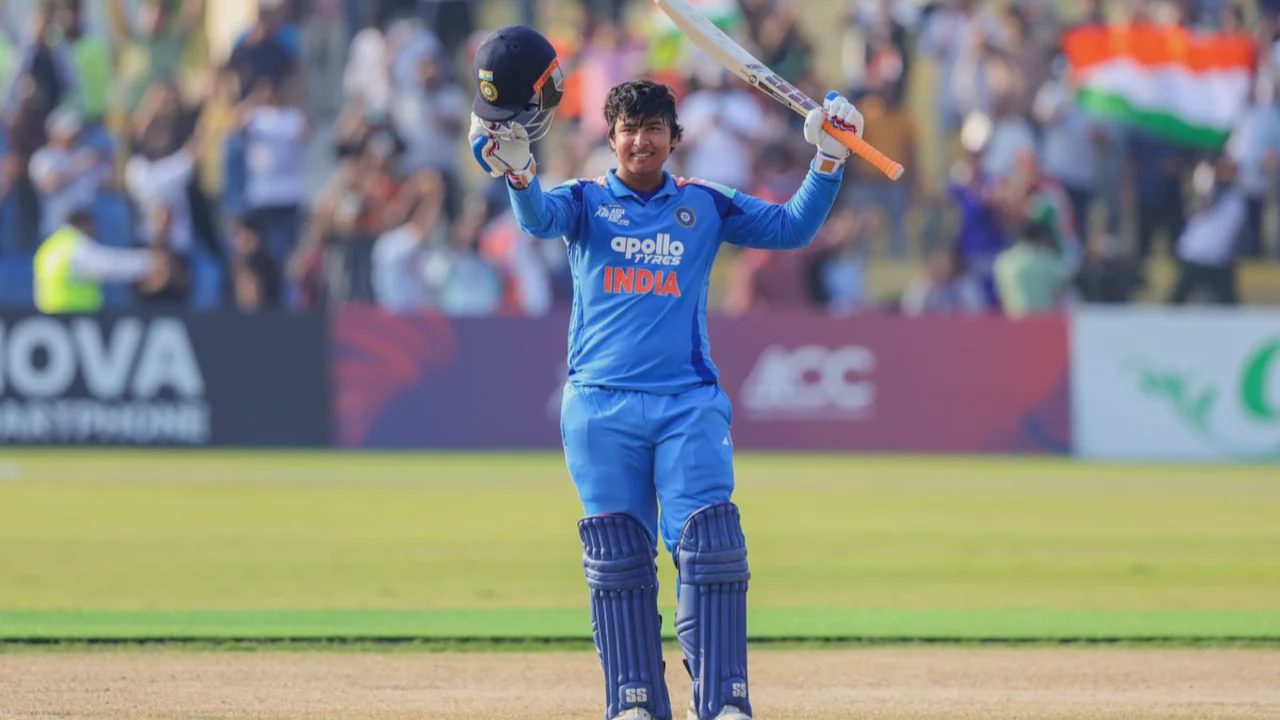
The teenager has made a mockery of the bowling, the boundary and the record books. So much so that, hours later, waxing eloquent, Suryakumar Yadav posted on X that Sooryavanshi is his ‘inspiration’. But getting into India’s ODI team is a different game altogether. After the storm had blown over, I looked at the scorecard. To me, it looked hacked. Vaibhav Sooryavanshi rampaged to 204 off 53 balls against the UAE in Doha. The knock was studded with 28 sixes. It was a double century made in 53 deliveries. A target of 250 was chased down by India A in 14.2 overs. The UAE batters had spent 50 overs putting together a respectable total. Sooryavanshi needed barely a quarter of that time to turn the chase into a demolition job.
At 15, he is already doing things that make statisticians look for a Sooryavanshi-like spreadsheet. But before the clamour begins for an India ODI cap, there is a small matter of the Indian team itself, which is not exactly short of batters at the moment.
The bat has apparently stopped believing in geometry
Watching Sooryavanshi on Tuesday was not merely about watching a young batter hit sixes; it was also about trying to understand the angles through which some of those sixes came.
At the start of his career, the teen would have been given a manual that had straight drives, cover drives, pulls, hooks and sweeps. He seems to have misplaced it or simply not bothered to have a look. Some of his shots appear to begin with one intention and end up in an entirely different postcode, or the ball lands somewhere near a tree. The bat comes through at an angle that makes you wonder whether the ball has been struck or redirected by a particularly mischievous traffic cop.
Some of the shots truly seem to belong in a superhero comic because when a bowler sets a field for a conventional stroke, Sooryavanshi finds a route that the field may not have been informed about.
There is something delightfully unorthodox about the way he generates power. He does not always need a grand, classical swing to send the ball soaring. His hands, bat face and timing seem to negotiate their own arrangement.
And the remarkable thing is that the ball keeps agreeing.
The numbers are almost absurd. Of his 204 runs, 196 came in boundaries, 28 sixes and seven fours. Only eight came from running between the wickets. It was a boundary festival with the occasional jog thrown in for variety.
India’s ODI team is not a vacancy waiting to be filled
It is not easy to be an Indian team selector in these times. While a record-breaking innings creates a wonderful package for television studios, it makes the job of the selection committee truly complicated.
India’s top order is crowded with established international batters and players who have been making a strong case in the 50-over format. Shubman Gill, Rohit Sharma and Virat Kohli have occupied the conversation for years. And the next layer is not thin either.
Devdutt Padikkal’s List A numbers are extraordinary, with an average of 82.23. Sai Sudharsan, too, has built a formidable record in the format, averaging 59.80. These are not players waiting for someone to explain what a 50-over innings looks like. They have been doing the grind in domestic cricket for seasons against a variety of bowling attacks.
Sooryavanshi may have made the selectors sit up, but wiser heads know that there is a distinction between being an exciting batting prospect and being ready to take up a particular role in an international side. India do not simply need another player who can hit sixes. They need to know where he fits, what happens when the ball stops coming on, and whether he can build an innings when the field spreads and the easy boundaries dry up.
The 50-over game has a middle, and it can be a very long one
The UAE attack was on the receiving end of a remarkable assault. But international ODI cricket will offer a different examination.
There will be spells when the ball is moving. There will be quality wrist-spin and left-arm spin, fields designed to deny the boundary, and bowlers who are not simply trying to survive the next six deliveries.
Can Sooryavanshi switch gears? That is the big question. Can he go from scoring at a strike rate of nearly 385 to a situation where India need 75 off 100 balls? Can he keep the scoreboard ticking without forcing a shot that is not on?
These are questions to be answered through experience, not through a selection debate conducted in the afterglow of one extraordinary afternoon.
He has already shown that he can score at a breathtaking rate. The next stage is to show that he can control the rate, too.
This was not quite a Desert Storm
The comparison with Sachin Tendulkar’s Desert Storm innings in Sharjah was inevitable. Both performances have the same intoxicating quality: a young Indian batting phenomenon taking an opposition attack apart and leaving the cricket world scrambling for superlatives.
But here is how the two are different. Tendulkar’s 143 against Australia in 1998 came in a high-pressure international tournament, against a formidable attack, in a chase shaped by the need to qualify for the final.
While chasing a target, he was also negotiating a qualification equation in a weather-affected match.
Sooryavanshi’s 204 was a List A record, and it was spectacular. But it came against the UAE in an India A match, in a chase that India completed with extraordinary ease. The opposition had posted 249, and India A reached the target in 14.2 overs.
Desert Storm was not only about the number of runs. It was about the opposition, the stakes, the tournament and the moment. Sooryavanshi has delivered the sort of innings that could become the start of a memorable chapter.
The sensible next step is not to rush the ending
There is no need to hurry because the teenager is just 15. His talent is not in doubt, and the records he has broken are not going to be erased by a few quiet innings. The best thing India can do is give him the right runway, keep him playing senior cricket, let him learn the rhythms of the 50-over game, and allow him the time to develop the less glamorous parts of batting that eventually separate a phenomenon from a dependable international player.
He may well force his way into the ODI conversation sooner rather than later. But the point is not to turn every extraordinary innings into an immediate demand for a cap.
India should be excited, and the selectors should be interested. But fans and decision-makers should allow him to grow.
Because the most exciting thing about his 204 was not that it made him an exceptional ODI player overnight, but the clarity of thought and execution. By absorbing the knowledge of greats such as Yuvraj Singh and applying it effectively, he has already made the future look interesting for Indian cricket.