
‘The Jhulan effect’ — that’s what a near-obsessive search for the next Jhulan Goswami in the Indian women’s cricket ecosystem is called in jest. Who wouldn’t want another speedy maverick cut from the same cloth as the Bengal superstar? Tall, quick, incredibly disciplined, handy with the bat and, perhaps most importantly, commendably fit until the very end.
Jhulan, who walked into the sunset as the leading wicket-taker in ODIs with 255 scalps, belongs to a bridging era in Indian women’s cricket when pace bowling wasn’t the trendy option. Spinners headlined proceedings, while pacers were the fillers.
“In the beginning of my career, Amita Sharma [the incumbent selection committee chair] and Rumeli Dhar were there alongside me. Then came Snehal Pradhan and Shikha Pandey, followed by Mansi Joshi, Meghna Singh and Pooja Vastrakar, who made space in the team. India was always considered a spin-bowling side. That myth changed when our generation — Ami, Rumi and me — came in. Our pace attack started being talked about,” Jhulan tells Sportstar.
Cut to 2026, and India is a flourishing cradle for seamers.
While raw, explosive pace is not yet as abundant as India would like, bowlers with control, variations and gusto have emerged from various parts of the country. The existence of the Women’s Premier League (WPL) has only fanned the flames of a desperate need that was identified close to a decade ago: developing a pace pool that can pose problems for opponents, especially on international wickets.
However, India seems stuck in an unimaginative loop of emerging talent getting caught in the quicksands of injury and losing valuable time at the topmost tier of the game.
Pooja, Amanjot Kaur and Kashvee Gautam have missed World Cups due to persistent niggles and lengthy recoveries, while others, like Renuka Singh Thakur, have had patchy game time due to workload issues and stress fractures. A depleted pace attack, among other factors, left India red-faced after another group-stage exit at the T20 World Cup.
When Jhulan was settling into the sport, players had no access to speed-gun metrics. Indians are masters of jugaad (hacks), and this issue had one too.“We often procured them when we toured abroad. Before that was possible, I used to tell our coach, Sudha (Shah) ma’am, to note our speeds and keep from broadcasting them. I also spoke a lot to the opponent batter and would ask how the ball felt. The ball needed to hit the sticker of the bat. I wanted to beat the batter, come what may. In the nets, I also always asked the keeper, and tried to train with one facing me. Today, things are much different,” she notes.
Now, empirical tools are widely used. CricViz consistently places Jhulan in the 125-128 kmph range, despite competing in an age where modern-day staples such as nutrition monitoring, biomechanical experts and strength-and-conditioning staff were hard to come by. One outlier reading even puts her at 132.1 kmph during the 2016 Women’s T20 World Cup.
Among Indian pacers since the 2000s, Amita Sharma has a recorded fastest speed of 128.90 kmph, while Shikha Pandey’s top speed is 124.35 kmph. Kranti Gaud and Arundhati Reddy, with 119.62 and 118.51 kmph respectively, are the closest to the 120 kmph mark. But the former — young and still developing her game — has struggled with consistency in control. Arundhati, meanwhile, relies more on disciplined rhythm and variations to stay economical, take wickets, or both.
But is the search for a speedster who can match or, better still, surpass this benchmark possible in a system that forces its talents to bowl slower?
Winning or developing?
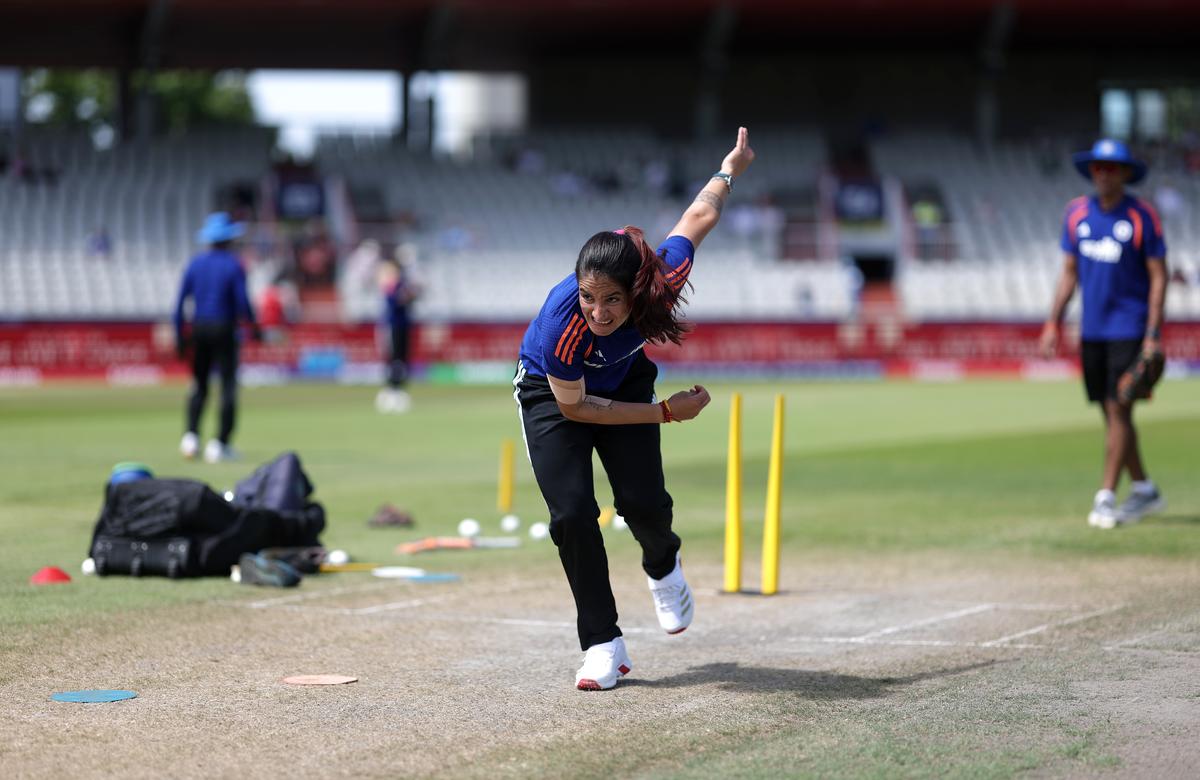
Some of India’s best spinners today — from Deepti Sharma and N. Sree Charani to even Poonam Yadav — started out as medium-pacers. However, factors such as a relatively small build or the tendency to concede runs because of their pace steered these players towards spin.
“After close to 10 years of senior cricket, I found a coach who told me to become a leg-spinner,” Ananya Upendran, former cricketer and lead scout for Delhi Capitals, says.
“I had a teammate, Sravanthi Naidu, who started off as a medium-pacer but switched to left-arm spin and got picked for India. She then came back to the domestic system and bowled two full seasons of pace. She switched to left-arm spin again and got picked for India once more. It’s so annoying, but hopefully that trend is changing,” she shrugs.
“We don’t use pacers enough in domestic cricket,” declares Neetu David, former chief selector of the women’s national team (2020-2025). Incidentally, 12 seam-bowling options were handed debuts across both white-ball formats during her committee’s tenure.
“Even today, we tell State associations to give pacers at least 10 overs, even if they bowl in spells of two, three or four overs. If they don’t play in the States, it gets tough to bring them up to the national level. But States want to win championships, and that’s understandable too. Coaches worry about results ruining their record. They find their spinners are more proficient wicket-takers and turn to them. Rajeshwari Gayakwad used to open the bowling for Team India,” Neetu recalls.
Pace brings an unpredictability that both Ananya and Neetu feels domestic decision-makers largely wish to avoid. The ball could beat not just the batter but the fielders too, running away to the boundary.
“I can tell you from my own state, Uttar Pradesh, where we had very good pacers, but the earlier coaches used to say, ‘You are too erratic and bowling too fast. Please slow down and just swing it.’ So the kid would start thinking: If my catches get dropped, there’s no point; the coach will drop me from the team,” Neetu explains.
Shikha corroborates this experience.
“We play in smaller grounds, with 55-yard boundaries and fast outfields. There were so many instances when I would bowl, just miss the stumps or get an inside edge. I might have a slip and a third in place, but the edge would hit a hand and run away for four. That four would be remembered. I had mentors like Purnima Rau who encouraged me to bowl fast, but that was in a domestic system where only one medium-pacer would be fielded.”
“I just hope our girls get really strong and start hitting spinners too,” she quips.
Neetu’s tenure also saw the BCCI organise several pace-bowling camps, which brought age-group talent under the Board’s ambit for monitoring and high-performance training. But a foundational change in the selection process itself was also needed.
“When V.V.S. Laxman took charge at the National Cricket Academy, which later became the BCCI’s Centre of Excellence, we discussed clear criteria for every player. For spinners, that was 12-15 wickets, and a similar bar was set for pacers too. But we had to tell him that pacers don’t get enough match time or overs. So the criterion was relaxed to a lower wicket bracket. We brought in specialist coaches to work with these girls. We even had Australian bowling consultant Troy Cooley at the NCA and later with the women’s team too,” she says.
Doubling up as all-rounders
“The runs bowlers get for you are the ones that give you games,” Shikha Pandey recalls former head coach W.V. Raman telling the team. She remembers a tense international match in which she and spinner Radha Yadav stitched together a crucial 17-ball, 22-run stand to snatch a three-run victory.
For years, India’s inability to make its tail wag has been a bête noire. As a result, domestic coaches no longer view batting as a luxury for fast bowlers; it is an absolute prerequisite for survival.
Sukhwinder Singh Bawa, coach to medium-pacer Nandni Sharma, explicitly trained her to finish tight games under pressure. In the nets, he created situational simulations — 15 runs needed off 10 balls — forcing Nandni, who bowls a clever 110 kmph seam-up delivery and a dipping slower ball in the low 80s, to master lower-order hitting.
“My trademark has always been developing all-rounders, from Yuvraj Singh to Reema Malhotra,” Bawa explains. “The idea was to ensure selectors saw that she could bat, maybe even promote her higher up the order.”
Nagesh Gupta, coach to international seamers Amanjot Kaur and Kashvee Gautam, is equally blunt about the national setup’s demands. “The team suffers because the batting thins out after number six. Just bowling is a tough pathway now. Everyone is bowling — so who in the pool can bat well? Producing all-round performances in pressure games is a necessity.”
This push reflects a global game increasingly dominated by pace-bowling all-rounders — from South Africa’s Marizanne Kapp and Annerie Dercksen and England’s Nat Sciver-Brunt and Issy Wong to Australia’s formidable assembly line featuring Ellyse Perry, Annabel Sutherland and Nicola Carey, among a host of others.
It’s a tough balance. Nagesh’s academy trains 55 girls in the 8-10 age bracket, of whom 25 are pure batters and 16 are pace bowlers.
But in India, this dual requirement has not settled in seamlessly and has come at a steep physical price. Nagesh notes that as young seamers rise through the ranks, the demands of bowling express overs and contributing with the bat can trigger severe workload issues.
Gaps at the grassroots
“The spike in injury rates is natural and will continue for a few years. The women’s game has exploded, and bowlers are now expected to do something different from what they trained for,” Welsh high-performance fast-bowling coach Steffan Jones says.
“There are biological differences, and so pace programmes for men and women, or boys and girls, need to accommodate them. India largely has a one-size-fits-all approach,” he explains.
“Early specialisation is a problem in India. A youngster who likes cricket takes it up, and that’s it. The robustness and athleticism needed for it are never developed. On the other hand, in England, for instance, a young bowler would probably do a lot of gym work and training, but not enough bowling. No country has really nailed the balance,” says the newly announced Mumbai Indians bowling consultant.
After the 2017 ODI World Cup, Shikha Pandey approached Jones hoping to unlock higher speeds. His recent work with Indian men’s team all-rounder Nitish Kumar Reddy, whose marked improvement in pace was there for all to see, underlines that this can be done. But the parallels end there.
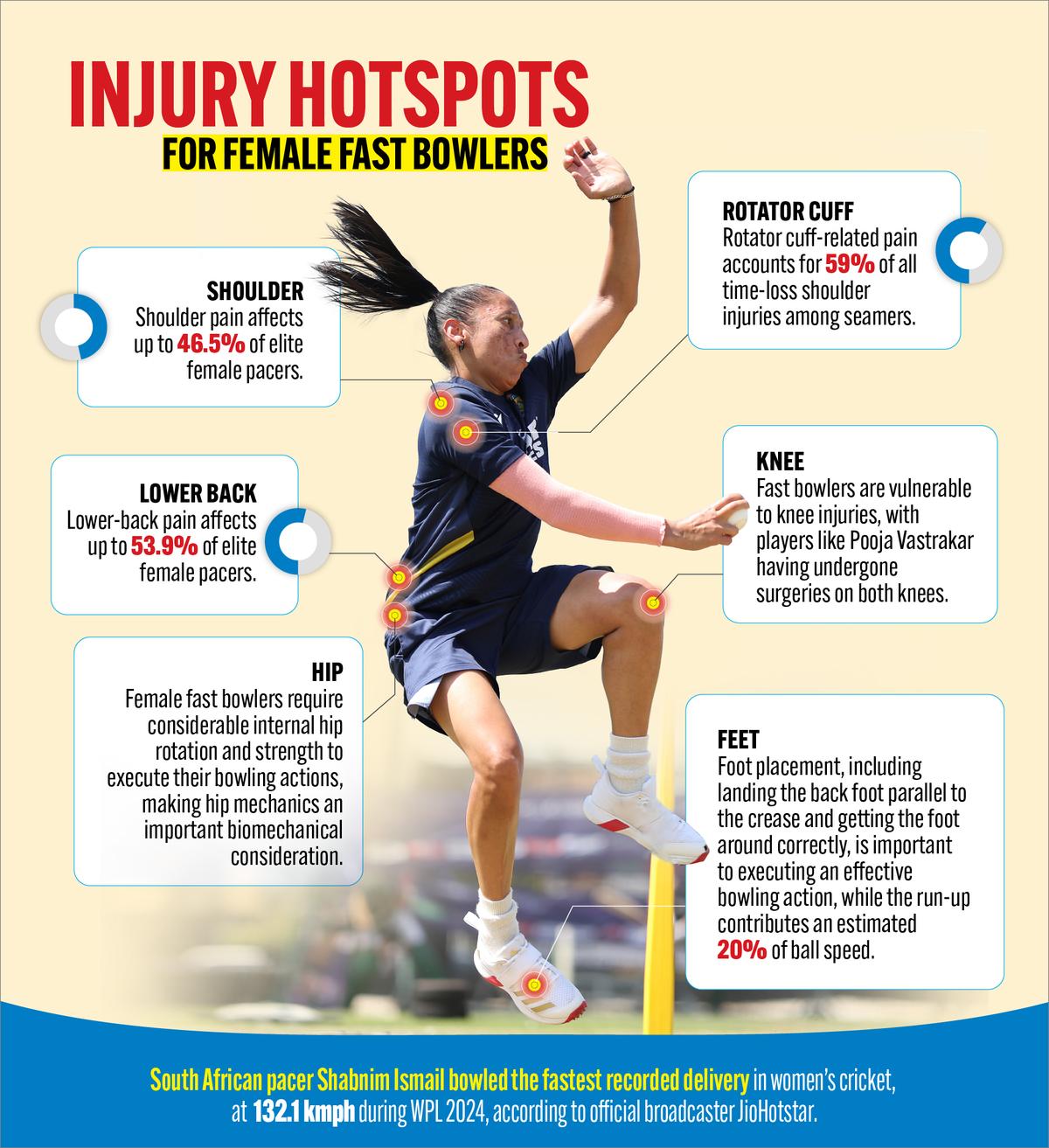
“Nearly 20 per cent of ball speed comes from your run-up. Too many female bowlers have short run-ups. So if you’re removing the momentum you get from a proper run-up, the force goes somewhere else. That’s potentially the crease, with angular momentum and rotation, which takes a lot out of the body because this depends on strength and muscle.
“Women can run as well as men, just a bit slower. If we’re discouraging them from running and attacking the crease, we’re making the game harder for female fast bowlers,” he says, citing run-up tweaks as one of the elements he worked on with Shikha.
An Australian study on non-elite female pacers shows that, unlike men — who generate velocity by bending forward at the waist — female seamers show no statistical relationship between forward trunk flexion and release speed. Instead, 89 per cent of speed variation in female pacers is driven by delayed arm circumduction and torso rotation.
“Female bowlers should be encouraged to have a more midway or front-on bowling action. We can’t teach them to be side-on, with the back foot parallel to the crease. I call them hip-and-knee-dominant bowlers. Men run with their pelvis open. But the female body can’t get its foot around because it needs a lot of internal hip rotation and strength, which the female body often can’t do. I encourage my trainees to be more like jumpers and sprinters, not side-on bowlers.”
But the route to that is not about overdoing any one element. “Practice doesn’t make perfect; practice makes permanent,” he underlines, advising against overbowling young cricketers and emphasising the need to “bulletproof the body” instead.
Matt Mason, former England women’s pace-bowling coach, found the lack of foundational bowling work a challenge. “The first difference between men and women is how they’re brought into the game. They haven’t bowled as many overs as young men. Usually, the age-group programmes available to boys aren’t available to girls. Males bowl more and so have built a little more resilience. Add the biomarkers that are different for both genders to this. What we’ve found is that when we put our athletes in safe positions, we put them in better positions to perform well,” says Mason, who is now with London Spirit in The Hundred.
He cites Freya Kemp as an example of a pacer who took up 50-over cricket and made her international 50-over debut in the span of a few months. That would never happen in the men’s game.
“Women and girls recruit a lot of their physical strength to bowl fast, whereas men don’t. Men use the technical model far more efficiently. The girls rely on strength and rotation. So that means they have to be very strong because they’re going to use those muscle groups. But then, obviously, we know there’s a gap in that area as well. The frustration for me is that, at the very beginning of their cricketing journey, potentially in the 12-14 age group, some of these habits have already formed. That’s where our coaches need to be,” he adds.
Repeatable actions also do not guarantee adaptability in high-pressure situations. This is Jones’ biggest gripe with how training systems work.
“A net session or an intensive training block is still not up to match-day intensity. It isn’t preparing bowlers. The stress of competition, crowds and the context of a match cannot be replicated in the nets. But the game still runs on this notion that we need to bowl more and train more. If you get a bowler to go at the stumps for an hour, I promise you the deliveries they bowl in the second 30 minutes will not be hard enough. Fast bowling is a mental activity too. It’s about going flat out for a few seconds and then having full recovery,” Jones argues.
Jhulan’s own experiences corroborate this.
“As a new-ball opener, we barely got new balls to train with in the open nets. So, learning to control was done on the go in matches and was quite challenging. I’d have people casually tell me, ‘You’re going too fast and erratic. Bring down the pace, swing the ball more.’ With all due respect, I quite happily ignored them,” she gushes.
The many deaths of pace
In a batter’s universe, a bowler’s currency is the dot ball. Accuracy over speed, then, becomes the formula to dry up runs.
“You’re given these cones and asked to bowl 30 balls in that box. When you’re young and quick, you’re not accurate. And if you want to finish that session, you have to do as told. Pace dies in that compromise,” Ananya adds.
Visakhapatnam-based pacer Shabnam Shakil, who emerged as a credible raw-pace option at the U-19 level, is a case in point.
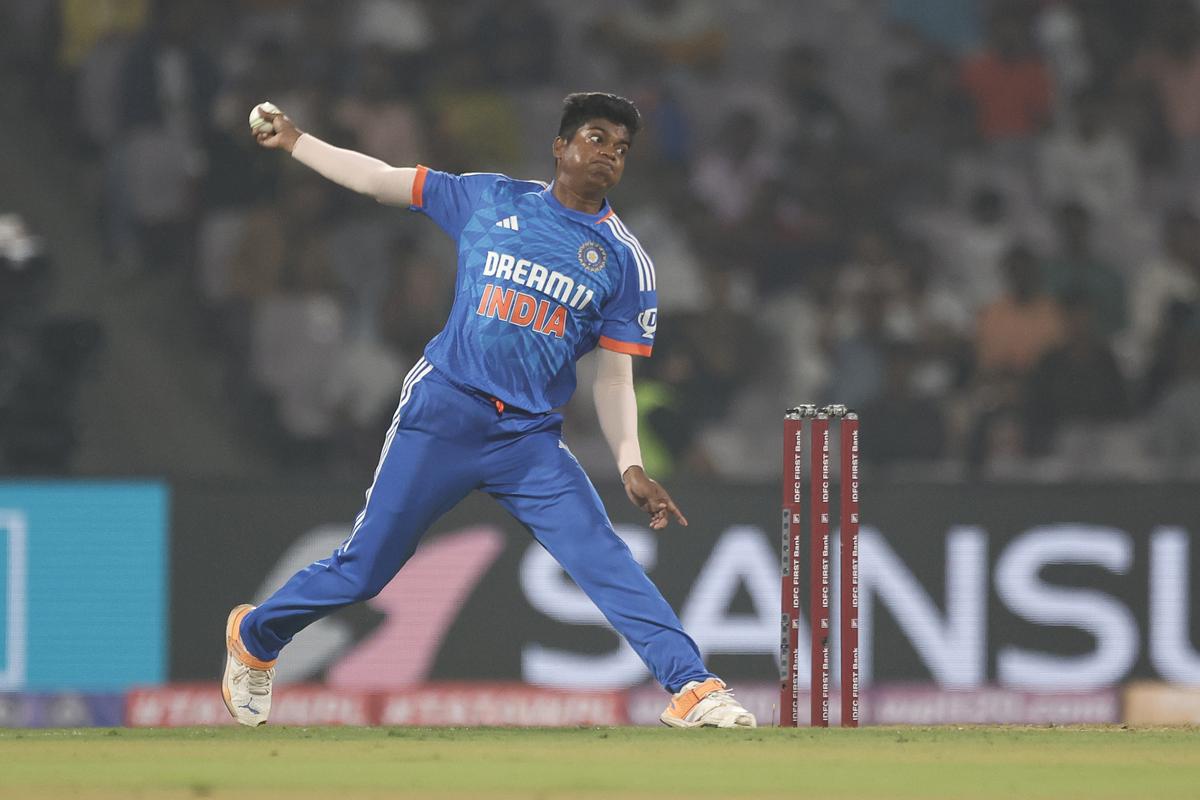
“We just bowl young quicks into the dust. Look at Shabnam. She’s been playing cricket non-stop since 2022. She was clocking 113 kmph at one stage. Her body is developing. She was invariably in every state and NCA-level camp. It’s good to see faith in them this way and a desire to keep them in the system. But we need to remember these are developing women and we shouldn’t push them ahead until they are ready. The 5 kmph drop in pace she had at one point, with a heavily strained action, was inevitable,” Ananya explains.
Shikha believes age tiers exist for a reason. Promoting youngsters should also come with pragmatism.
“Shabnam was playing U-16, U-19, U-23 and senior cricket at the domestic level. She wasn’t getting any wickets, but was directly fast-tracked into the senior team. I keep harping on this. You have an U-23 side because you don’t want players dropping off after U-19, but you don’t want U-19s playing seniors all the time either. Their development needs to follow that physical gradation too, sometimes,” she points out.
It doesn’t help that fast bowling has been quantitatively identified as the single most injury-prone role in women’s cricket, according to an Australian review of shoulder injuries from 2015 to 2023.
Furthermore, a study conducted at the University of the Witwatersrand, Johannesburg, found injury prevalence reaching up to 53.8 per cent among pacers. Among the potential problem areas, lower-back pain affects up to 53.9 per cent of elite female pacers, while shoulder pain impacts up to 46.5 per cent.
Take Pooja’s case. Long viewed as India’s premier pace-bowling all-rounder, she has spent years navigating a relentless cycle of injury and return — most recently enduring an 18-month layoff following surgery to repair a torn supraspinatus tendon in her bowling shoulder, a textbook casualty in a sport where rotator cuff-related pain accounts for 59 per cent of all time-loss shoulder injuries among seamers. She’s also had previous surgeries on both knees.
During her recovery, Royal Challengers Bengaluru signed her for the WPL strictly as a batter. Working under England seam legend Anya Shrubsole, she gained a vital psychological lifeline.
“My pace was all over the place, but RCB told me my batting was enough,” she recalls. “That confidence came at a time when I felt inadequate for this game.”
“Injuries toh hoga (injuries are inevitable). Look at the spurt in matches and series now. We played two or three series tops, and then there was the odd year with ICC events or tournaments like the Asia Cup. Now that number has tripled, and so has the intensity,” Jhulan argues.
There’s an incongruence in the way injuries are handled in this environment, according to the veteran pacer.
“The issue is that players get injured, work on recovery and slot right back into the national side. Game time there becomes wonky, and you give it your all in the odd chance you’re given. That actually isn’t good for your recovery. This is where the domestic system should be used. Go back, play games and work your way out of the injury. We have the infrastructure to monitor and tweak things there, in synergy with the national side.”
Learning from the best
India has plenty to learn from its two main international adversaries.
Australia, easily the mecca of pace in women’s cricket purely because of the quantity of credible pacers it regularly produces, has more granular initiatives such as Project130. A partnership between Cricket New South Wales and the University of Technology Sydney (UTS), its stated objective is to plug the research gap that pushes cricket to condition female bowlers according to frameworks designed for men. The venture aims to help female fast bowlers reach the 130 kmph-and-above spectrum and stay there, while keeping injuries to a minimum.
England’s Women’s Pace Bowling Programme, launched in 2024, has also been working closely with tier-one counties to groom and induct pace-bowling talent into the mainstream. An important additional focus of the initiative is identifying taller athletes transitioning from sports such as netball and basketball, and tapping into their natural potential for bounce and, maybe even, raw pace.
It helps that their domestic teams are closely intertwined with franchise systems and, by extension, the national side’s interests. The Women’s Big Bash has State-based teams, making the pathways uncomplicated, as does England with its county setup.
India’s WPL, in this regard, stands out. With just five teams carrying the ambitions of a nation of 1.4 billion, calls to add another team (or two) got a renewed push after the recently concluded auction for the 2027 edition.
Ananya is still undecided about whether the WPL is purely a boon for Indian pace bowling.
“In the initial stages, not many franchises looked at grooming as a priority or at building players over four to five seasons within the setup. It’s a new tournament, and teams are still finding their feet. We’ve started seeing that change slowly now. The next couple of years, and perhaps the addition of teams, will make a difference to how much ownership teams take of their players’ growth arcs.”
The road ahead
Mason hopes the system will eventually render someone like him redundant, where bowlers won’t need him anymore — something a coaching-intensive setup like India’s can adopt. He cites Lauren Bell’s example while illustrating how a bowler who never really set her own fields is now a free-thinking phenom. Likewise, he cautions against changing bowling techniques for the sake of it, suggesting intervention only when necessary. Both are areas where Indian systems still have considerable catching up to do at the domestic level.
Neetu and Jhulan, apart from sharing an almost military-level precision in their bowling, also believe players should learn to deploy their skills on flatter tracks without the usual creases on the forehead.
“The modern game values runs, which is why these wickets are a lot more popular now. I’m not praising myself, but back in my time, people used to say that David could turn the ball even on a cement wicket. I feel even today, despite it being a batting wicket, as a bowler, you can still do well there,” Neetu says.
“International cricket is played on flat tracks, right? The younger kids coming through need to hone their skills on flat tracks, so let that be an added challenge. Spinners can maximise turners, and seamers can make use of moisture early in the morning to effect some damage. We see bowlers often clueless on flat strips. We want to avoid that,” Jhulan adds.
She also vehemently denies that height is a prerequisite for a pacer, despite an Australian study titled ‘In-match analysis of elite female cricket pace bowlers’ identifying height as the single best physical predictor of release speed. It explains that 53 per cent of speed variation in female fast bowlers is due to longer lever arms. Taller bowlers also have higher run-up velocities.
“Look at Shabnim Ismail [the South African pacer who bowled the fastest recorded delivery in women’s cricket, at 132.1 kmph during WPL 2024, according to official broadcaster JioHotstar]. She’s not tall, but she bowls so fast. She is a genuine seam bowler. She runs so smoothly. I often feel there are springs under her feet,” she adds.
A new appreciation for speed also brings with it a rush of people claiming they can help players go up a few gears.
“First, assess whether the action is injury-inducing. Once the action becomes safely repeatable, drills for fast bowling, such as brace-leg or arm-delay routines, can be done. Posture can be fixed as well, and we can safely see a 4-5 kmph increase. That’s the maximum you should aim for. Many academies claim to make a 15 kmph increase possible. Do not fall for that. Fast bowling is a natural thing, and you must listen to your body,” Nagesh warns.
Most importantly, Jhulan believes, it is perhaps high time India separated its pace pool by format to ensure smoother team outcomes and, more importantly, player welfare.
“We need 10-15 players in a seam-bowling pool whom India can use rotationally. Place players in ODI, T20I and Test duties, respecting their strengths and limitations. Batting roles are so well-defined. Do that with bowlers too. And the push India had a few years ago to make the top and middle order bowl as well was novel. It gives the captain options and contingency plans,” she explains.
Pace bowling in the women’s game has long needed greater intent. The next step may not be finding another Jhulan, but building a pool deep enough that India never again depends on one. Only then will the chase for 130 kmph become realistic.
Published on Nov 19, 2026