
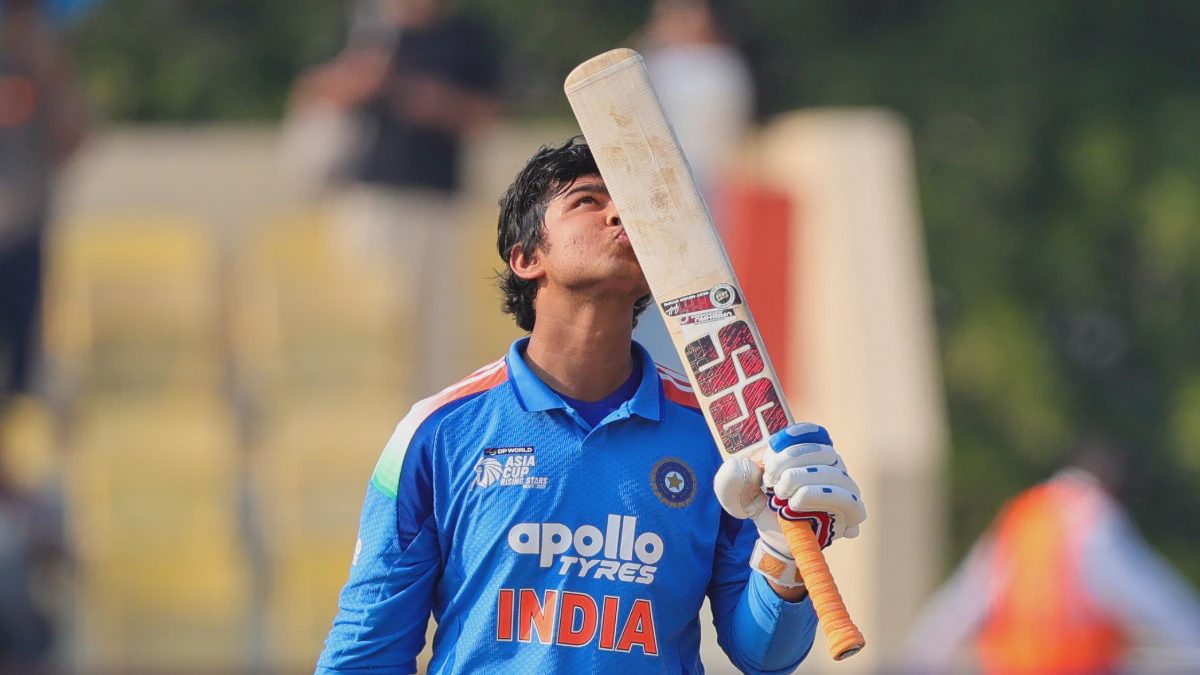
New Zealand bowling coach Jacob Oram believes it is too early to call Vaibhav Sooryavanshi the saviour of ODI cricket, but he knows the teenager can be a handful for bowlers.
Vaibhav Sooryavanshi hit 204 off 53 balls in Doha, breaking the record for the fastest List A double century (Courtesy of BCCI)
New Zealand bowling coach Jacob Oram does not believe Vaibhav Sooryavanshi should be labelled the saviour of ODI cricket just yet, despite the teenager’s stunning exploits with the bat. Oram, however, has no desire to see the 15-year-old produce another 50-ball double century against New Zealand.
Sooryavanshi made headlines on Tuesday with a breathtaking 204 off just 53 balls in a List A match. The knock has once again brought ODI cricket’s future into focus, with T20 cricket continuing to attract a growing audience.
Oram believes the format still has a place in the game and feels it is too early to put such expectations on a 15-year-old.
“It’s a bit cool to call a 15-year-old the saviour. Let’s see how it pans out. I understand the public love their T20 cricket and the purists love Test cricket, but I still believe there’s a place for 50-over cricket,” Oram told PTI in an interaction.
The former New Zealand all-rounder was quick to acknowledge Sooryavanshi’s appeal, describing him as an exciting addition to the game. He also had a light-hearted warning about facing the youngster.
“He’s exciting, he’s entertaining, and the more of those players involved in cricket, the better it is for the product. I just hope he doesn’t get a 50-ball double hundred when we have to bowl against him,” he said.
HAGLEY OVAL PITCH EXPECTATIONS
Oram also shared his thoughts on the Hagley Oval surface ahead of the second Test against India, which begins on Friday in Christchurch. He expects the pitch to offer more pace, bounce, and movement than the Basin Reserve surface in Wellington, where only 24 wickets fell across five days. However, he believes conditions could become easier for batting as the match progresses.
New Zealand will assess the surfaceand weather conditions before deciding on their bowling plans.
“We won’t make a final decision on those bowling plans until day one on Friday. Obviously, we’ll see what happens with the overheads, the temperature and the wind, how much it dries out and the colour change that we see,” Oram said.
“But we’re hoping that there’s obviously a little bit more bounce and movement than we saw in Wellington. We’re also hoping we potentially win the toss for a change as well.”
The presence of grass on the pitch does not necessarily mean batters will struggle throughout the match, Oram said. He pointed to the Wellington Test, where India made the most of the conditions early on before the surface eased out.
“New Zealand produces nice wickets. I think sometimes people get a bit scared off by the amount of grass. We do have wickets that start very green or pretty green, but they can dry out pretty quickly as well.
“As you saw in Wellington, I thought the Indians bowled really well on that first morning, first half-day, and then look how flat that got after that,” he said.
Oram also recalled last year’s Test against the West Indies at Hagley Oval. The visitors batted through the final day to secure a draw, with Justin Greaves scoring a double century.
“It can flatten out and there can be a lot of runs scored here. You look back 12 months to the West Indies Test here where they managed to bat out the last day for a draw. Justin Greaves got a double century.
“It looks tough to start, but if you can get over that hump, then the batting becomes easier,” he said.
ORAM DEFENDS KIWI BOWLERS
Oram was also keen to defend his bowlers after the Wellington Test, insisting their efforts were better than the scorecard suggested.
He felt New Zealand had created chances early in the match but failed to capitalise on them. India then made the most of their opportunities and put together big partnerships.
“There were a couple of dropped catches early and there was a review that, if we had decided to take it, an LBW could have gone our way. But that’s what happens sometimes in cricket. Before you know it, they put on a 100 or 200-run partnership and the game gets away from you.
“I thought we bowled well. If you forget the scorecard and just look at where we wanted to pitch the ball, the lines and lengths, we weren’t far away for a lot of that time from what we wanted to do.
“They just played well and the opportunities didn’t come our way,” he added.