
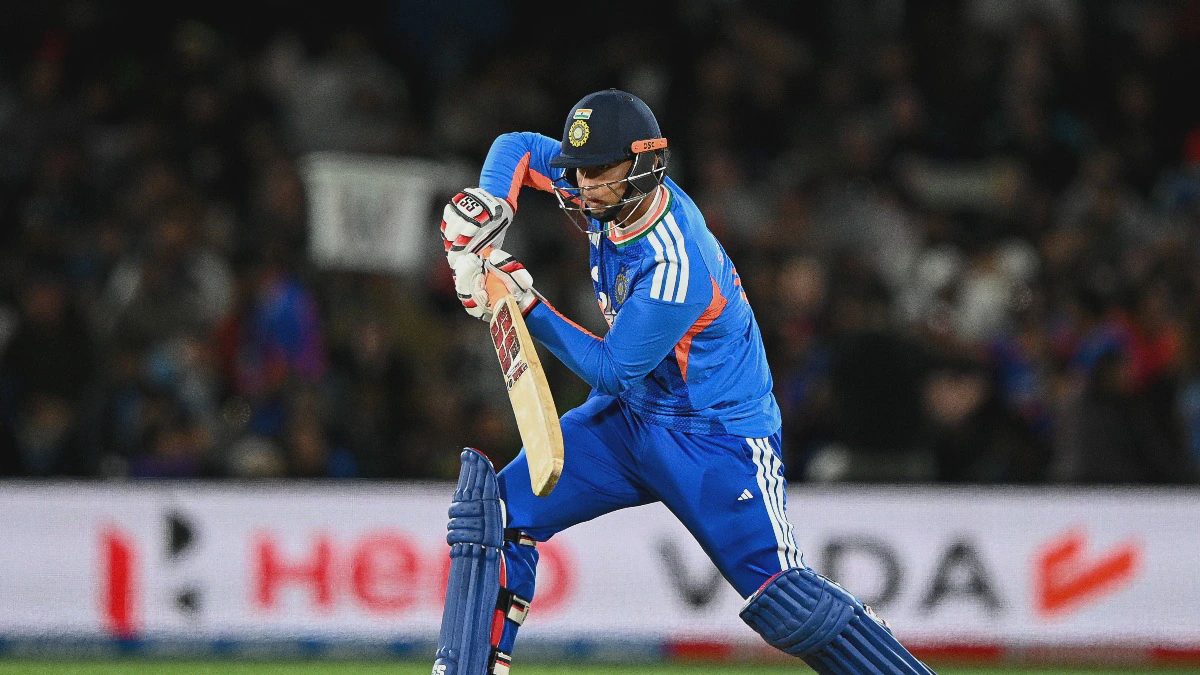
Vaibhav Sooryavanshi’s ability to take on bowlers from the word go has made him one of the most exciting young batters in the game. His power and range of strokes leave little room for error, and even experienced bowlers can find themselves searching for answers. Former New Zealand all-rounder Chris Harris, however, believes there is one way to make life difficult for the left-hander: keep him guessing.
Harris was never the quickest bowler around during his playing days, but his ‘dibbly-dobbly, wobbly’ deliveries often proved more troublesome than batters expected. The veteran of 250 ODIs and 23 Tests believes variations in pace and length would be essential against a batter like Sooryavanshi.
“Vaibhav being a left-hander, I’d literally try to bowl a bit more back of a length and take it away from him. I know he’d take me on, but if you’re bowling on the kind of surfaces we used to play on, which would hold up, he’d try to hit those balls over mid-wicket and the leg side,” Harris told news agency PTI.
“He’s got such power and is good all around the ground. Then I’d bowl some that went across him. I’d just keep mixing it up and hope he missed one or got an edge. But when those batters get in, sometimes there seems to be no way to stop them.”
The 57-year-old feels the demands on bowlers have changed considerably. During his playing days, slower surfaces often made it difficult for batters to play through the line. The modern game, with its bigger strokes and fearless approach, leaves bowlers with far less margin for error.
“I think we played in an era when the wickets were a little slower and held up a bit. That suited our style. We could bowl in a good area, and it was difficult for the batters. They felt they could play a big shot, but they had to take risks.
“Now, when you watch batters play, they almost have no fear. They just take you on every ball. If I were playing in the modern era...you’d have to keep mixing it up, coming up with different variations, mixing your pace and length.”
Harris believes T20 cricket arrived about 10 years too late in his career. He did get a taste of the format with Canterbury and in Zimbabwe, and enjoyed the all-round demands of the game.
“Yes, T20 probably came about 10 years too late for me. I love the T20 game. I got to play a little bit for Canterbury and, as you said, I played a little bit in Zimbabwe.
“I love the game because I’m, as you said, a bits-and-pieces player. I love to field, bowl and bat and do a little bit of everything. I think it really suited my nature because I’m pretty hyperactive. You certainly have to be hyperactive in that game,” he reflected.
Although he never got an IPL opportunity during his playing career, Harris would have liked to work with a franchise as a fielding coach. He believes he could help young players improve their fielding.
“I would have loved to have gone over to the IPL. If I could have gone over as a fielding coach, that would have been something I prided myself on during my playing days.
“I think I could certainly help in that area. There are a lot of sides around the world that I watch and feel I could help with some basic fielding drills, monitoring and helping young players. That’s something I’m really passionate about. I still feel young enough to be able to help in a fielding capacity. Perhaps in the future, that would be something I’d love to do.”
Harris had a couple of years with Zimbabwe’s Under-19 team but did not pursue full-time coaching. He also continued playing senior cricket in Christchurch until the age of 52.
“I did enjoy my time coaching. I spent a couple of years in Zimbabwe, which I absolutely loved. There were some great young players over there. I always wanted to be involved in cricket, but I don’t think full-time coaching was the job for me.”
Away from cricket, Harris spent four years working as a medical representative. His job involved supplying surgical devices, human tissue and instrumentation, and occasionally taking him into operating theatres to assist surgeons.
“I did that for four years and loved it. I used to bring in devices and human tissue from America and go into surgery. I did that for about four years and absolutely loved it.”
“As a medical representative, you’re supplying the devices or the tissue, and generally the instrumentation as well. You don’t really do anything; you’re just there to assist the surgeon, to know how things work and what size screw or driver to use.
“I got to meet a lot of surgeons and absolutely loved my time in the medical industry for about four years.”
He remains involved in sports broadcasting, doing occasional radio commentary for Radio New Zealand and working on Sky’s Super Rugby coverage, particularly for Crusaders and Highlanders matches.
Harris’s full-time job is now with ePay, a company that handles gift cards and prepaid cards sold through supermarkets in New Zealand and Australia. The run-up to Christmas is its busiest period.
“My full-time job now is with a company called ePay. We do all the gift cards and Prezzy cards, which are available in supermarkets. This time of the year is extremely busy because the Prezzy card is the perfect Christmas gift if you’re not sure what to get someone,” he said with a chuckle.