
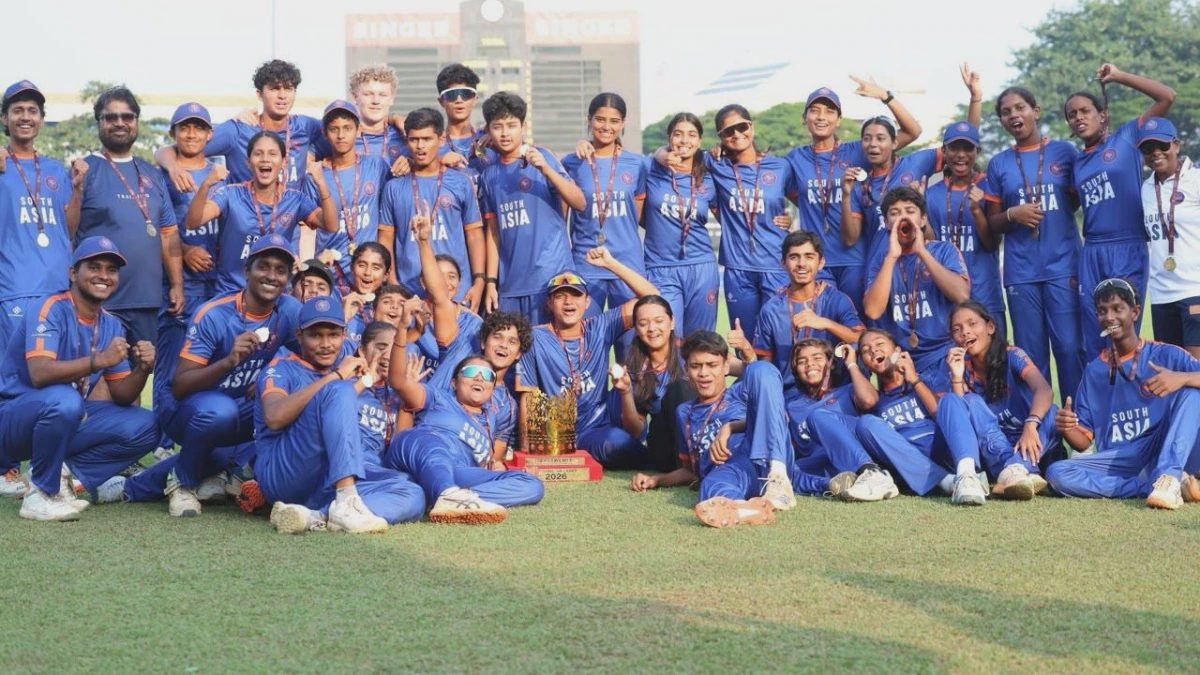
Virat Kohli’s nephew Ayush Dhingra starred with the ball as Rajkumar Sharma-mentored South Asia defeated AB de Villiers’ Sub-Saharan Africa by eight wickets to win the inaugural Test Twenty title. South Asia’s girls established a crucial three-run lead before the boys completed a dominant victory in the final.
South Asia beat Sub-Saharan Africa by 8 wickets. Courtesy: Test Twenty
South Asia, mentored by Virat Kohli’s childhood coach Rajkumar Sharma, scripted history by becoming the inaugural Test Twenty champions after defeating AB de Villiers-mentored Sub-Saharan Africa by eight wickets in the final at Colombo’s SSC Cricket Ground on Sunday.
Kohli’s nephew Ayush Dhingra played a decisive role in the triumph, producing an impressive bowling performance as South Asia finished with an aggregate score of 224, edging past their opponents’ 223.
The final was a closely fought contest, with South Asia’s girls giving their team a crucial three-run advantage before the boys took charge to complete the job. The girls’ team finished with 139/3 in response to Sub-Saharan Africa’s 136/4, setting up a modest target of 85 for the boys.
Dhingra, the son of Kohli’s elder sister Bhawna Kohli Dhingra, returned figures of 3/15 in his four overs to help bowl out the opposition for 87. His contribution earned him the Player of the Match award, which he shared with Suhani Bharatkumar Kahandal, who starred for the girls.
The victory also settled a closely contested rivalry between the two teams, who had earlier played out the first-ever drawn match in the tournament.
SUHANI LEADS GIRLS’ FIGHTBACK
South Asia is mentored by Virat Kohli’s childhood coach Rajkumar Sharma. Courtesy: Test Twenty
Sub-Saharan Africa made a promising start after opting to bat, posting 136/4 in their 20 overs. Kanchan top-scored with 54 off 40 balls, hitting five boundaries, while Peyton Hulme provided a late flourish with an unbeaten 27 off 18 deliveries. Payal Jakhar also chipped in with 19.
South Asia’s bowling effort was led by Aditi Angad Lande, who picked up two wickets for 22 runs in three overs. Siya Chugh and Suhani also claimed a wicket apiece to restrict the opposition to a manageable total.
In reply, South Asia’s girls held their nerve to finish on 139/3 and secure a narrow but valuable three-run lead. Suhani was the standout performer, remaining unbeaten on 60 off 44 balls. Her innings featured six fours and a six, providing the stability South Asia needed in the chase.
Siya offered useful support with 29 off 34 deliveries, helping her side stay ahead despite Swarnim Gaur’s impressive spell of 2/16 in four overs. Kanchan picked up the other wicket.
That three-run advantage proved decisive in the overall contest, putting the boys in a strong position heading into their part of the final.
DHINGRA’S THREE-WICKET HAUL DERAILS AB’S TEAM
South Asia’s boys made full use of the advantage created by their female counterparts, producing a disciplined bowling display to dismiss Sub-Saharan Africa for 87 in 14.2 overs.
Joseph Hopkins offered some resistance with an aggressive 31 off just 18 deliveries, striking four boundaries and two sixes. However, the rest of the batting line-up struggled to build partnerships against a relentless South Asian attack. Ekam Saini’s 15 was the only other notable contribution.
Ayush Dhingra picked up 3 wickets. Courtesy: Rest Twenty
Dhingra emerged as one of the biggest stars of the innings, claiming three wickets for 15 runs in his four overs. The young cricketer, who is related to former India captain Kohli, made important breakthroughs to put South Asia firmly in control.
Aditya Bhatt was equally impressive, picking up two wickets while conceding just 10 runs in his four overs. He also bowled 14 dot balls, keeping the pressure firmly on the opposition. Harshit Tiwari and Tanush Apte chipped in with two wickets each as Sub-Saharan Africa were bundled out for 87.
With just 85 runs required for the title, South Asia were firmly in the driver’s seat. However, they suffered an early setback when Harshit was dismissed off the very first delivery of the chase.
RATHOD PRODUCES MATCH-WINNING BLITZ
Any hopes of a dramatic comeback from Sub-Saharan Africa were quickly extinguished by Sai Gopal Rathod, who produced a breathtaking batting display to take South Asia across the finish line.
Rathod remained unbeaten on 54 off just 24 deliveries, smashing seven fours and four sixes. His aggressive approach ensured that South Asia never allowed the early dismissal to become a problem.
He combined with Shourya Shailesh Jadhav to put together a crucial 70-run partnership for the second wicket. Jadhav contributed 13 before Tanush Apte added further momentum with a quickfire 10 off just four balls.
South Asia eventually reached 87/2 in just 7.2 overs, completing an emphatic eight-wicket victory and sealing the inaugural Test Twenty championship.
Rathod’s performance in the final was another highlight of an impressive tournament. He had earlier announced himself with an unbeaten 109 against Europe, and carried that form into the title clash with another match-winning contribution.
Dhingra and Suhani were named joint Players of the Match for their respective performances in the boys’ and girls’ contests.
A NEW FORMAT FINDS ITS FIRST CHAMPIONS
Sir Clive Lloyd gave the trophy to the inaugural champions. Courtesy: Test Twenty
The inaugural Test Twenty tournament, held at Colombo’s SSC Cricket Ground from November 14 to 29, brought together 160 cricketers aged between 13 and 21. Four continental teams competed for the title, with each side combining the performances of its boys’ and girls’ teams to determine the overall result.
The teams were mentored by some of the biggest names in cricket. Former India coach Rajkumar Sharma guided South Asia, while South Africa legend AB de Villiers was in charge of Sub-Saharan Africa. Former Australia batter Matthew Hayden mentored Australasia, while West Indies great Sir Clive Lloyd led Europe.
The occasion also received a special touch when Lloyd presented the trophy to the inaugural champions. The former West Indies captain famously led his country to the first two Cricket World Cup titles in 1975 and 1979.
For South Asia, the triumph marked a memorable beginning to a new tournament. For Dhingra, it was an opportunity to make his own mark on the cricket field, with a match-winning contribution in a historic final.
Result: South Asia beat Sub-Saharan Africa by eight wickets