
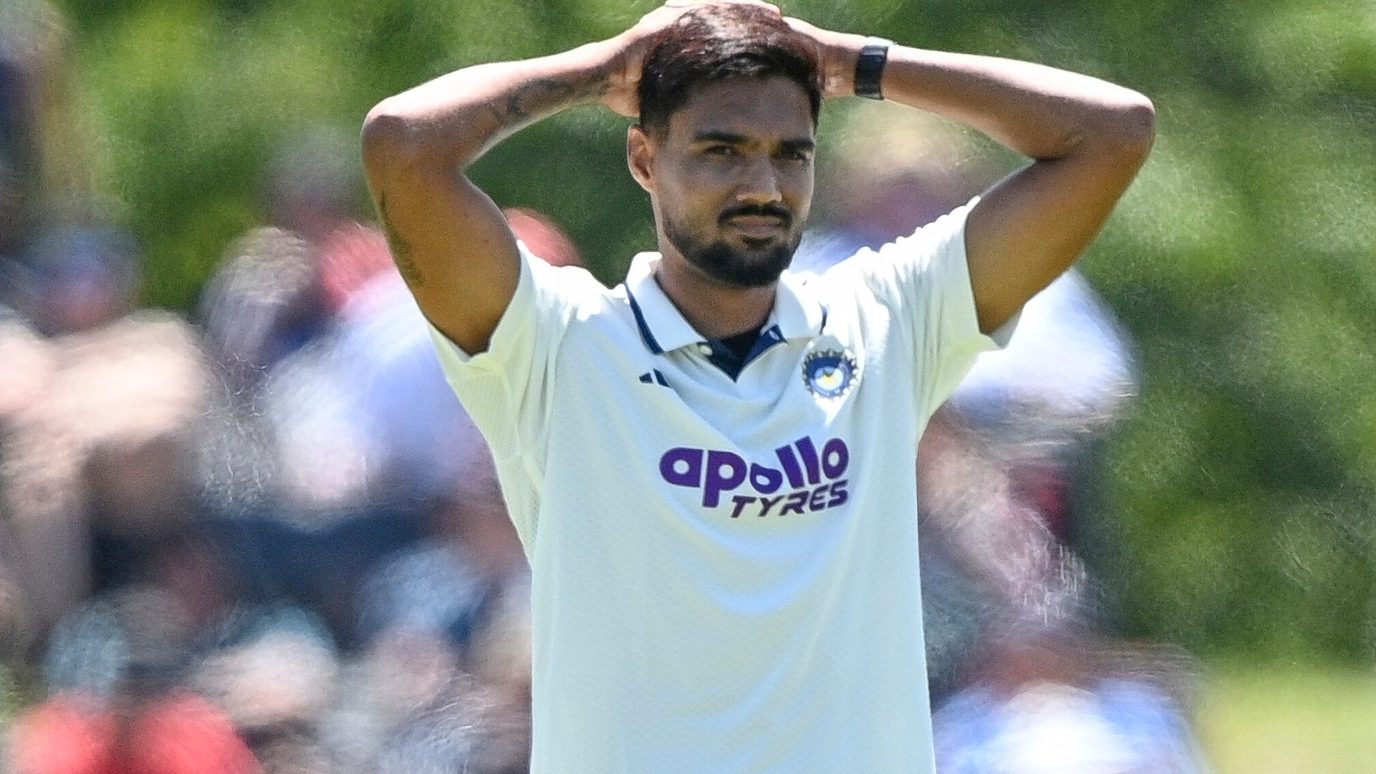
In keeping with a trend that is becoming quite commonplace, India again made a change to their playing XI for the second Test in Christchurch, blooding tall pacemanGurnoor Brar. The 26-year-old’s USPs are his height (six feet, five inches) and speed (he repeatedly breached the 140 kph mark on his first day in Test cricket).
Gurnoor Brar became the 321st player to represent India in Test cricket. (AP)
The man going out was Prasidh Krishna, also tall (though not as tall as Brar) and also quick (again, though not as quick as the man from Punjab). Like for like replacement? Hmm…
Exactly three months to the day, skipper Shubman Gill had nothing but effusive praise for Prasidh, who had bowled his heart out while taking seven wickets in the two Tests in Sri Lanka. As much as the wickets he prised out on pacer-unfriendly tracks in Galle and the SSC ground in Colombo, the 30-year-old Bengalurean caught the eye with his control and the regularity with which he harried and hustled batters.
At the end of the series, Gill remarked, “He’s been the pick of our bowlers. When things are not happening, he’s been our go-to bowler, especially this season. He’s made things happen for us. He’s created chances, which is what I want as a captain. We expect our bowlers to create chances so that it should feel like a wicket can come here or there. He did that brilliantly.”
Prasidh played one Test thereafter, in Wellington last week. He went for 100 runs in the first innings in 26 overs when Gill again used him to try and bounce New Zealand out on a track that flattened out after offering assistance to the quicks on the first day.
In the second innings, Prasidh was excellent with his lines and lengths, easily India’s most impressive bowler as they tried to get through the Kiwi middle order. His pace and awkward bounce even on the benign deck posed the most uncomfortable questions, and his persistence and extra bounce earned him the scalps of Henry Nicholls, who had defied India in making an unbeaten 175 in the first innings.
Even accounting for New Zealand’s go-slow on the final day, Prasidh’s figures of 19-10-23-2 (economy 1.21) were little short of outstanding. His reward — five days of rest at the Hagley Oval, on a track that has more pace, bounce and sustained movement than the one at the Basin Reserve did. A chance to put his feet up and watch the entertainment from the changing room.
Confusion reigns
Over the last several months, India’s selection methodology has been confusing, if not steeped in confusion. Nothing illustrates this better than Prasidh’s omission (unless he was injured and unavailable for selection, about which there is no official word).
When Mohammed Siraj was dropped for the first Test, we were informed obliquely that it was because of ‘lack of form’. One can’t accuse Prasidh of being out of form, not after the captain’s glowing encomiums just one Test ago and not after his tremendous show at the Basin in the second innings. Yet, he finds himself warming the same bench as Siraj when he could and should have been out in the middle, trying to help the team’s cause with World Test Championship elimination looming large.
India’s pace attack for Hagley read Jasprit Bumrah, Anshul Kamboj, Akash Deep and debutant Brar. Take away Bumrah (who endured a rare wicketless day), and the others had a combined experience of 13 Tests. Prasidh himself hasn’t played a great deal — 10 Tests for 35 wickets — but his strike rate of 47.5 balls per wicket are far superior to Akash (57.8 before the start of the second Test) and Kamboj (94.5). And yet, in its collective wisdom, the Indian think-tank decided that it would be better off leaving out Prasidh, perhaps because it didn’t fancy playing him and Brar in the same XI.
If there is a case to be made for yardsticks being applied differently, let’s look at Kamboj. Flown into Manchester at almost the last moment because Arshdeep Singh’s Test debut had to be put on hold due to a split webbing, he was embarrassingly ineffective, finishing with unflattering figures of 1/89 from 18 overs in England’s only bat.
He was down on pace, barely threatening 130 kph, and seldom beat the bat. It’s now being revealed in whispers that he wasn’t fully fit for the Test, though there was no sign of any injury in the nets at Old Trafford the previous day when he hit the bat hard and made a compelling case for his inclusion.
In Wellington, Kamboj bowled 45 overs across two innings for returns of 3/114. But he also weighed in with an entertaining 38 as the nightwatchman, and therein lies a tale. From all accounts, Kamboj made himself a certainty for both Tests on this tour because he is considered reasonably handy with the bat (notwithstanding the fact that his first-class average from 41 matches is 15.47).
At a time when the hunt for WTC points is bordering on the desperate, India ostensibly chose to go with (possibly) a few extra runs at No.8 rather than place their faith in a bowler who was lauded to the skies by his captain not so long back, and whose last Test bowl was exemplary. Let’s try and find the logic in that.