
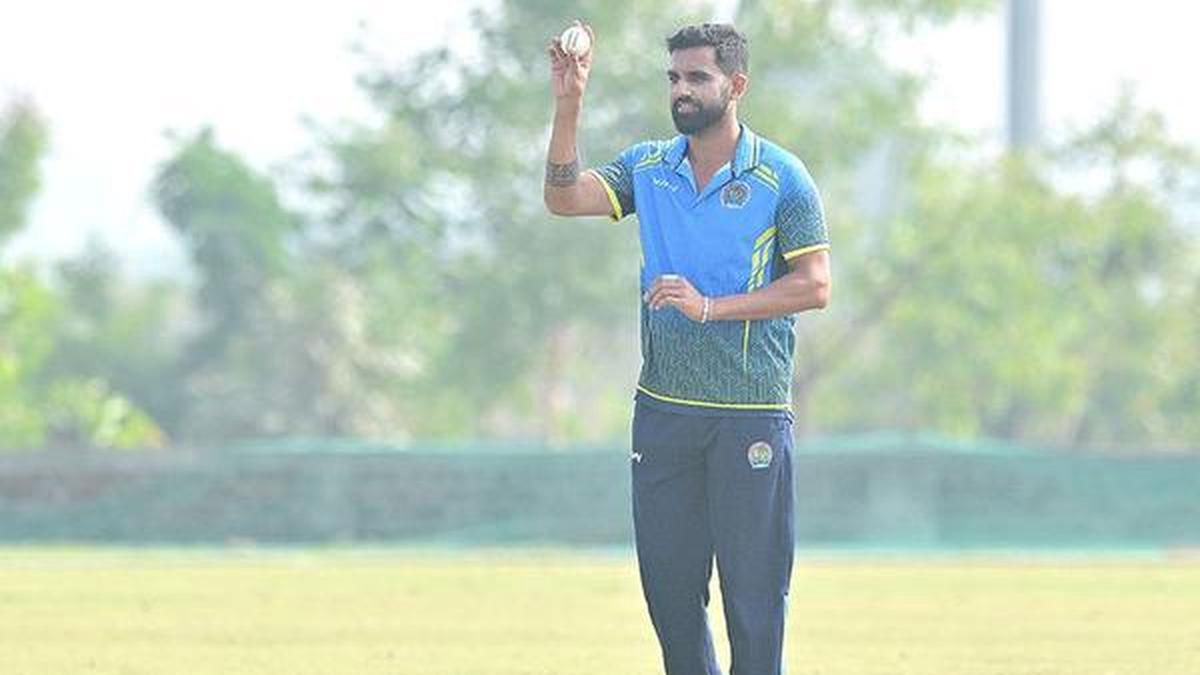
India international Deepak Chahar has called for greater consistency in the weight and quality of cricket balls, arguing that heavier-than-prescribed balls could be one of the reasons behind the reduced swing seen in the game.
The India pacer said he had personally checked 15 new Kookaburra balls about a month ago, while training and found that none weighed in the range of 156 to 161 grams, with several weighing considerably more.
“The umpires and the match referee told me the weight should be between 153 and 161 grams. But none of the balls I checked fell within that range. Most of them weighed 164, 165, 166, 167 or even 170 grams. Some were as heavy as 171 grams,” Chahar said on Thursday.
The standard senior men’s Kookaburra ball weighs approximately 156 grams, with the permitted range allowing for variation. Chahar, however, believes that even a difference of five to six grams could have a bearing on the ball’s movement through the air.
“Five or six grams can make a significant difference when it comes to the weight of a cricket ball and its ability to swing. A difference of 10 grams is massive. A heavier ball will travel more slowly and is also likely to swing less,” he said.
Chahar suggested that the authorities experiment with lighter balls to understand whether they could help bring more swing into the game. “If the ball is seven grams heavier, try giving them a ball weighing 148 or 150 grams and see what happens. The balls used in women’s cricket weigh 148 grams. Look at how much those balls swing,” he said.
The pacer also pointed to the growing demand for cricket balls across domestic tournaments and franchise leagues, saying maintaining consistent quality had become increasingly difficult. “Look at the demand across domestic cricket, regular leagues and the IPL. Every tournament requires a huge number of balls, and it is not necessarily possible to ensure that every ball is of the same quality. Manufacturing so many good-quality balls is not easy either,” he said.
The Rajasthan captain said he had raised the issue before the Syed Mushtaq Ali Trophy during the captains’ meet, suggesting that balls be checked and selected before use.
“I don’t see anything wrong with saying that we should select the balls before using them,” he said.
He also felt that pitch conditions partly explained why there was more swing in the Syed Mushtaq Ali Trophy than in the IPL, where surfaces tend to be flatter.
“Things have been better in the Syed Mushtaq Ali Trophy. The conditions are different from those in the IPL. The pitches are not as flat. In the IPL, generally, only one match is played on a pitch. Here, two matches have to be played on the same surface. If they don’t leave some moisture in the pitch, it will start breaking up.”
This was evident in the way the MCA-BKC surface behaved through the tournament. While it produced some high-scoring encounters, there were also several low-scoring games, with spinners coming into their own after the pacers had dominated the early exchanges.
Published on Nov 26, 2026