The voice of NZ cricket: Ian Smith on commentary, Richie Benaud and Sky’s return to cricket

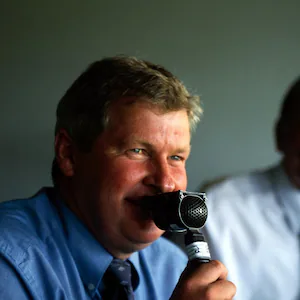
Former New Zealand cricketer and commentator Ian Smith is ready for a big summer of cricket. Photo / Photosport
While “Smithy” hasn’t been part of locally televised cricket here for five or six years, he has been in great demand abroad, keeping audiences informed around the world from India to England and every International Cricket Council (ICC) event in between.
As Smith prepares for his 50th season of first-class cricket, he reflects on a career that has brought enormous success on either side of the boundary rope.
“I have been, and I’ll say this very forthrightly, very lucky. Very, very lucky to be able to do something I’ve loved for pretty much my whole working life,” Smith says.
The former New Zealand cricketer kept wicket for his country long before the Black Caps nickname was bestowed upon the national team – in fact, he was already an established international broadcaster by the time it was adopted in 1998. And he could play.
Smith still holds the world record for the highest test innings by a number nine batter, amassing 173 off 136 balls against India at Eden Park in 1990. It was a breathtaking innings at a time in test cricket when breaths were too often taken by yawns.
He retired with the most test dismissals by a New Zealand wicketkeeper and has since watched Adam Parore, Brendon McCullum and B.J. Watling overtake him. In fact, he’s not only watched them, he has also narrated their careers.
“Every New Zealand player that I’m commentating with this year – Tim Southee, I did his whole career. Ross Taylor, whole career. Stephen Fleming, Scott Styris, Simon Doull, pretty much his whole career,” Smith says. He’s excited about the summer ahead.
“You get to know them pretty well as cricketers and then the other side of the coin is that you spend your summer with them and you socialise and you get to know the different aspects of them apart from the way they play the game.”
Sky’s return to broadcasting home internationals brings the voice of our summer game back into the commentary box.
“Yeah, it feels pretty good actually. When I finished with Sky five or six years ago, I didn’t expect that I’d be back.”
The barest of margins
What makes Smith such a special talent is the passion and exuberance he still has for the game, blended with immeasurable experience. The moments that he’s seen and lived, from either side of the boundary rope.
And, with mic in hand, he’s taken millions, if not billions, of viewers along for the sort of white-knuckle ride that live sport thrives on. Smith describes each moment with that world-famous Kiwi cricketing humility – and authenticity.
“I don’t have an exercise book full of sayings. I don’t have a script. One of the things is that I fell out of love with playing cricket, and that’s why I finished playing, but I never fell out of love with the game. I never, ever fell out of love with the moments in the game. I think that’s, that helps me,” he says.
“First thing you’ve got to realise is that you only get one crack at it. You can’t come back tomorrow and do it again. The other thing is that you’ve got to put yourself in that moment.
“People have sort of said, ‘Where did you get that from’? Or ‘why did you say that?’ And I just basically say, ‘well, that’s the first thing that came to my head’.”
Smith’s most famous line came in the heartbreaking finish to the 2019 World Cup final at Lord’s, when England edged New Zealand by way of scoring more boundaries – despite tying after 50 overs and again after a “Super Over”.
But he has a library of moments that he’s had the honour of calling.
“I wasn’t scheduled to commentate Brendon McCullum’s 300 at the Basin Reserve that Monday morning in Wellington, where businessmen and businesswomen were lined up outside, especially for that moment,” he says.
“I wasn’t first on and I thought, knowing the way Brendon plays, it wouldn’t take him half an hour to get six or seven runs or whatever that he needed. But, it did. All of a sudden I found myself on the spot. That was hugely invigorating and exciting for me.
“Glenn Maxwell batting on no legs [he had severe cramps] to beat Afghanistan in the last World Cup in India where, I think, Australia were gone for all money and he scored 200 not out.
“Sitting alongside Ricky Ponting, Shane Watson was in the middle chair. Two Australians who thought they were done and dusted, and it was going to be one of the biggest upsets in World Cup history, and all of a sudden, Glenn Maxwell batted them out of it.
“It could have ended at any moment, but the fact that he couldn’t walk, he could not run, he could not properly take a stance, he was cramped up and dehydrated that much that it was like a movie.
“I think we described it at the time as ‘you’ll probably never see this again’.”
In the middle
Cricket audiences under the age of 50 will certainly be aware of Ian Smith the commentator, but they may not recall Ian Smith the cricketer. While his broadcasting career has taken in many more games than his 12-year international playing career, he was still witness to some of the game’s biggest moments.
His introduction to international cricket came in 1980 against Australia in Australia. The white-ball stage of the tour will forever be remembered for the penultimate match in the one-day series at the Melbourne Cricket Ground.
Smith was the last man out, bowled by Trevor Chappell for four. That brought Brian McKechnie to the crease with New Zealand requiring six runs to win from the final delivery. Chappell bowled it underarm, McKechnie blocked it, threw his bat in disgust and the rest is history.
Five years later, Smith stood behind the stumps as Sir Richard Hadlee took 9-52 and 6-71 against Australia at the Gabba in 1985. Remarkably, Smith didn’t play a hand in any of the 15 wickets that Hadlee took – but the pair combined for what was then a New Zealand record of 43 dismissals throughout their careers.
Smith played in the first test win in England in 1983, the first series win in England in 1986 and the famous draw against Australia at the Waca in 1989, when Mark Greatbatch held out with an unbeaten 146 from 485 balls.
He faced West Indian speedsters Malcolm Marshall, Michael Holding and Joel Garner – as well as Aussie quicks Jeff Thomson and Dennis Lillee, and Pakistan’s frightening double act of Wasim Akram and Waqar Younis.
Smith played in Chris Cairns’ test debut at the Waca in 1989 and he played in father Lance Cairns’ final test at the Waca in 1985. His final international appearance came at Eden Park during the 1992 World Cup, a devastating semi-final loss to eventual winners Pakistan. He also had a front-row seat for that Inzamam-ul-Haq innings in the final round-robin game against the same opposition in Christchurch.
Smith has shared the field with some of the game’s greats. He’s shared the commentary box with many more.
Channel 9
Smith’s stocks as a world-class commentator surged after a guest stint in Australia in the late 1990s. He looks back on that period with great fondness.
“It was daunting, I love the Channel Nine team,” Smith says.
“I had a little bit of contact with them as a player because I think I broke a finger or something on a tour of Australia and I missed a few games. At the time, they wanted someone to go up and identify our players, particularly in the outfield, some that they had not known too well. Of course, back in those days there were no numbers or names on the back of shirts.
“I ended up doing a couple of commentary stints. It was daunting because they’re legendary in terms of the way they broadcast the game and each of them developed their own personalities and their traits and their status was huge around the world.”
In 2026, those same words accurately describe Smith – but back then, the master was an apprentice.
“Just very much a new boy on the block and speak when spoken to sort of thing and suck up all the knowledge and the technique that you can.
“Fortunately for me though, they were quite receptive and I made some friends as well as colleagues, which made the job a hell of a lot easier.”
Among the legendary commentary team – immortalised by comedian Billy Birmingham in The 12th Man series – were Richie Benaud, Tony Greig, Bill Lawry and Ian Chappell.
“Tony Greig was, I don’t know how you’d classify him actually, but he’d been involved in setting up the Channel 9 commentary team and he was very much an integral part of it as a friend and confidant of Kerry Packer himself. He had the status in the Channel 9 box and he’d let you know in no uncertain terms how he felt that you should perhaps go about things and he was often sort of giving you advice as well.
“He said, ‘Look, don’t ask Richie a question on-air, because he’ll feel if you’re sitting next to him, you should know the answer to that question’. You just developed a way of working with various individuals.
“Anyone who worked with Bill Laurie would know that he’s very busy, very up, he lives every moment of the game. He just absolutely has a passion for it. And you couldn’t compare his style to Richie really, because Richie was so laid-back.
“He [Benaud] kind of let the pictures do the talking and then when it came to describing a moment or describing a piece of action or a technique or whatever, that’s where he felt that he could help the viewer as opposed to lecture the viewer.
“He was a gentleman of the commentary box really and he developed such a status that you believed that whatever Richie said was pretty much the gospel.
“If you go back to how he described the underarm incident and the catch of Martin Snedden’s in the outfield, which all happened on the same day, you know, he had an opinion. He didn’t sit on the fence when he felt that something had to be said and stressed.
“He was pretty forthright in that.”
For the record, Benaud’s calm but matter-of-fact summary of the underarm incident, delivered during the closing monologue in-studio, was as follows.
“I thought it was a disgraceful performance from a captain who got his sums wrong today, and I think it should never be permitted to happen again.
“We keep reading and hearing that the players are under a lot of pressure and that they’re tired and jaded and perhaps their judgment and their skill is blunted, well perhaps they might advance that as an excuse for happened out there today ... not with me, they don’t.
“I thought it was a very poor performance, one of the worst things I have ever seen done on a cricket field. Good night,” Benaud said, finishing with raised eyebrows and a gentle smile.
Smith says he got to know Benaud well over the years.
“I was lucky because I actually worked with Richie Benaud for Channel 4 in England for four or five years,” he says.
“When you sit down in a commentary situation next to Richie, you were fully aware that you were sitting next to the best in the business, and every stint was a privilege.”
Smith recalls one stint in particular. It was 1999 and the New Zealand side were on the verge of history – their first-ever test win at Lord’s.
“We had some amount of runs left to win, maybe three or four to win. And he basically set it up and then put the microphone down and the producer in the back said, ‘look, Richie, you know, don’t forget the game’s about to be over’, and he basically said, ‘well, yeah, it is, but it’s New Zealand’s moment. It’s his moment’ looking at me.
“You don’t forget that.”
Smith knew what it meant to those players – and Benaud knew what it meant to Smith. He’d been part of three New Zealand sides who had dreams of becoming the first to win at the home of cricket – and three times he fell short.
“That taught me a hell of a lesson in terms of the moment and what it meant to people around you in the commentary box, and the special nature of commentary, really.
“That was Benaud. Benaud was an amazing man, and I think by the end of it, I’m happy to say that I classed him as a highly respected friend.”
The summer ahead
Smith will be a constant presence for Kiwi cricket fans this summer – leading the television broadcast of each international match on these shores as well as returning to Australia to team up with Fox Sports for the Black Caps’ upcoming test series.
“Channel 9 set the bar and Fox, in particular, I think, have carried it on and turned themselves into probably the best cricket production in the world,” he says.
“They have this appetite for never being satisfied. Where every day is a challenge for the producers, the directors, the people that put the packages together.
“You only have to look at the opening 30 seconds to one minute that Fox put on to a day’s cricket and the lengths they go to to set the scene is probably the best I’ve ever worked in, actually.”
Smith says he’s looking forward to that assignment – but he’s also fizzed about the home summer, starting in Christchurch on Thursday.
“Re-establishing Sky as the premier summer broadcaster, we’ve got a lot of work to do, you know, and it’ll be done. People have got an expectation and we’re going to meet that expectation and probably surpass it.”
At the helm of Sky’s sporting content is Gary Burchett. The vastly experienced Australian arrived in New Zealand a couple of years ago from India, where he held the roles of executive producer of the Indian Premier League (IPL), director of cricket and director of talent for Disney Star.
Prior to that, he led cricket at Fox Sports in Australia before taking on its head of news role. Smith knows the level of expertise that Burchett brings.
“When you produce cricket in India, you have a very high benchmark to make,” he says.
“There are millions and millions and millions [of viewers] around the world with expectations. Gary’s lived through that; to produce and provide a standard of cricket production in India is probably the toughest job that you can get in his particular role.
“To last as long as he did and reach the standards that they were able to at Star is no small reflection on what he can do. So what we’ve got here is an exciting time for him because he’s coming in at ground zero, really.”
Ground zero because Sky’s cricket production has been in the wilderness since it lost the rights to the now-defunct Spark Sport in 2020.
“Five or six years away from it, you feel as if you’re the new boys on the block all of a sudden. And what’s exciting about it is that the first one we do will probably be the most-watched production around the world because they’ll be watching in India and their multi-millions. They’ll be watching around the world.
“The beauty of that is that with Gary, he’s done it before under pressure and he’ll be relishing this opportunity, I’m sure.”
The same can be said for Smith.