
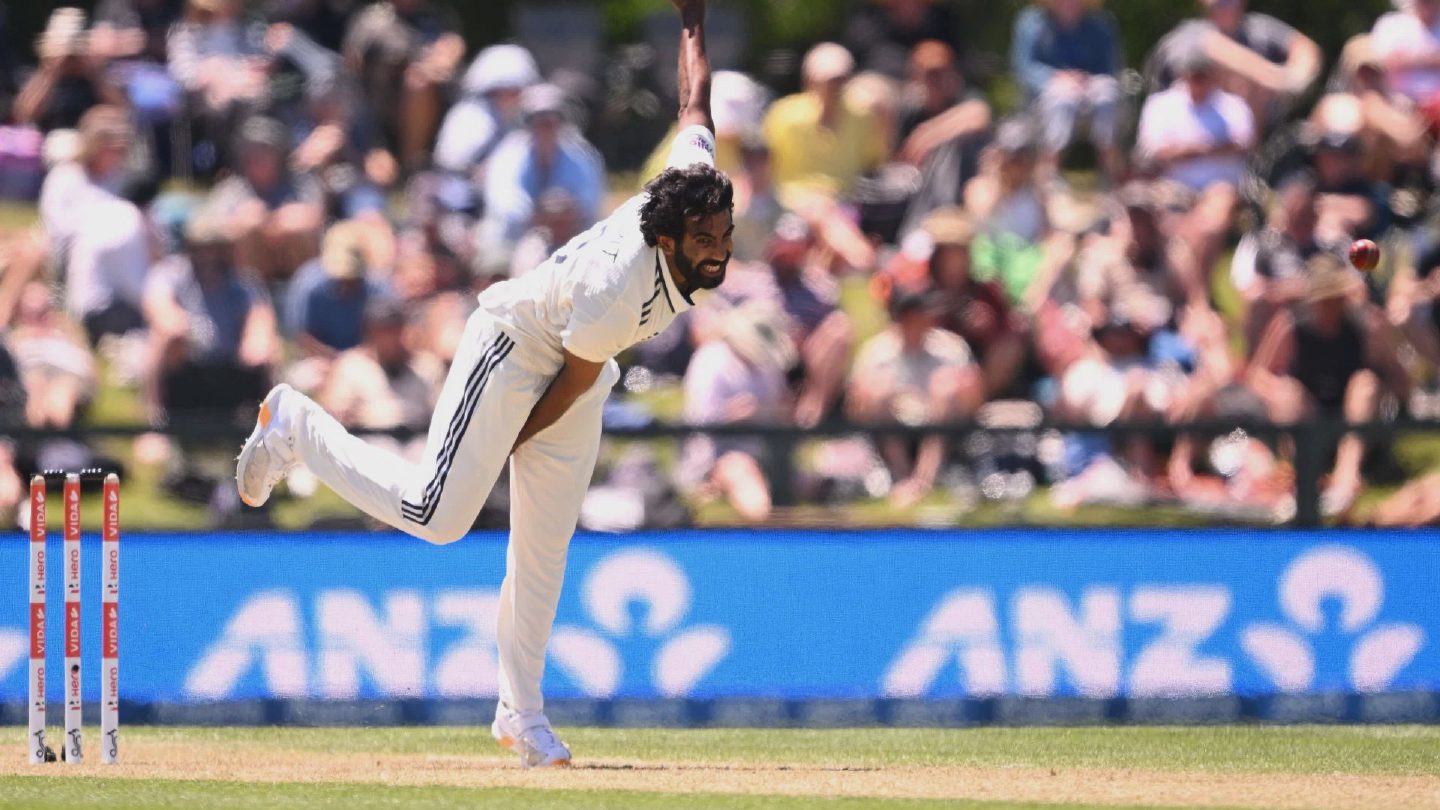
India star pacer Jasprit Bumrah has been a strange, silent act in the second Test against New Zealand in Christchurch, where bowlers are thriving on a significantly livelier surface than Wellington in the series opener.
Jasprit Bumrah bowled 26 overs in New Zealand’s first innings at Hagley Oval and finished with 0 for 49. Six were maidens; and his economy rate was 1.90. Although he did manage to keep the batters in check and created a few half chances, there was a noticeable difference in the way he operated. A drastic difference in pace and zip, and the uncharacteristic attempt to tweak his run-up are far from positive signs.
India won the toss and bowled on a surface that seamed through the first two days, and New Zealand still made 356. By stumps on day two, India were 116 for 6, 41 runs short of avoiding the follow-on.
It was the third time Bumrah had bowled 26 overs in a Test innings without a wicket, after the World Test Championship final against New Zealand in Southampton and the Lord’s Test against England, both in 2021.
Unlike those cases, this one came with a build-up courtesy of a bleak second innings spell in the first Test as well. He has now gone 274 balls without a wicket, a run that started after he dismissed Tom Latham in the first over of New Zealand’s second innings in Wellington.
On that note, let us take a look at three reasons why Jasprit Bumrah’s slump is growing to be a concern for India amid NZ vs IND 2026 Tests.
#1 His decline is clearly affecting India’s fortunes
The stature of Jasprit Bumrah and the overdependence on him is such that India’s good fortunes, especially abroad, lie on his shoulders. As a result, when the spearhead is not at his best, it is not surprising to see India’s bowling also not being at its best.
Jasprit Bumrah was thoughtfully underbowled on Day 5 of the first Test so that he could go all out in the second Test, but that has not been the case so far. Without his contribution and impact, New Zealand put on 77 runs for the first wicket on the opening day and added over 100 runs for their last five wickets. The ends of the batting order used to be Bumrah’s domain, and without his usual breakthroughs, India have suffered.
New Zealand turned 246 for 5 into 356, and India’s reply reached 116 for 6, with Yashasvi Jaiswal bowled by Matt Henry with the sixth ball of the innings and no partnership passing 37. Jasprit Bumrah in full rhythm would have ensured the total stayed below 300, but the extra runs have affected India in more ways than one already.
#2 India have a lot of quantity but no proven quality in the bowling unit
India did not arrive short of seamers for the tour, including a late addition at the expense of a frontline seamer. Jasprit Bumrah, Mohammed Siraj, Prasidh Krishna, Akash Deep, Anshul Kamboj, Gurnoor Brar and Nitish Kumar Reddy were all on the tour. That is a stacked pace unit, but only in terms of numbers, not in terms of experience or potency.
What the attack lacks is a second bowler whose record holds up when Bumrah has a quiet match. Siraj, India’s leading wicket-taker in the current WTC cycle, has not played either Test. Although the others have been decent in patches, it has not been a collective effort.
In the first Test, a four-man seam attack including Jasprit Bumrah took 15 wickets across the match, five of them being his. But in Christchurch, where something has been working for the bowlers, his numbers have surprisingly worsened. Akash Deep’s 5 for 99 from 31.3 overs was the only return that looked like a frontline bowler’s, while Anshul Kamboj and debutant Gurnoor Brar have only three Tests between them.
This is a problem across formats for India as they have a decent pipeline of bowlers, but they are far from ready for a transition after Jasprit Bumrah. The team management has tried a plethora of options in recent times, including veteran Bhuvneshwar Kumar, but a long-term solution is still not clear. As a result, it is crucial for India that Bumrah returns to his best, especially from the ODI World Cup 2027 perspective.
#3 Jasprit Bumrah lacking pace and zip after one game despite strict workload management
The workload plan has been as tight as India can make it. Bumrah was rested for the five T20Is and five ODIs before this tour. He had not bowled in a Test for 12 months, since the second Test against South Africa in November 2025. In the first Test, no spell of his ran past three overs, but he put in a shift after bowling a total of 49 overs in the match, the fifth-most in a Test in his career.
If that plan was supposed to produce a fresh, quick Bumrah in Christchurch, the evidence points the other way. He was clocked at 128.1 kph in the 48th over on day one, an unusual reading for him with a hard ball in his hand, and his speeds dipped through several spells.
There has been a cautious effort to protect Jasprit Bumrah, and understandably so. However, if the extreme measures are leading to breakdowns after one game, there should be fingers pointed at strength and conditioning or at accepting the workings of an ageing and fragile body that has already been through a lot.
The expectation after he was rested for the white-ball leg was that a full-throttle Bumrah would be on show in the Tests, but that has not been the case. With an intense 2027 coming up, with the Border-Gavaskar Trophy, the Indian Premier League, and the build-up to the World Cup 2027 and the tournament itself, there is pressure on Bumrah to return to his best.
Looking for fast live cricket scores? Download CricRocket and get fast score updates, top-notch commentary in-depth match stats & much more! 🚀☄️