Exotic cricket grounds
We look at some of the most unusual locations on which cricket venues were built.
We look at some of the most unusual locations on which cricket venues were built.
Campo Maximo, an upcoming cricket venue in Playa Flamenca on the Costa Blanca in Spain, aims to be one of the world’s most eco-friendly cricket venues … and eventually host a Test match and even the IPL. Other than its sustainable features, the ground’s outfield will use “a new type of artificial grass”, designed to let cricket be played on it all year round.
As we showed in our Cricket Explained video, cricket grounds come in all shapes and sizes. They can also be built on unusual foundations. If all goes well, Campo Maximo will join cricket’s most exotic venues. Here are some of them.
Play: Cricket in unusual locations quiz: Who was the first Test captain to play cricket in Antarctica?
An arboreal quartet
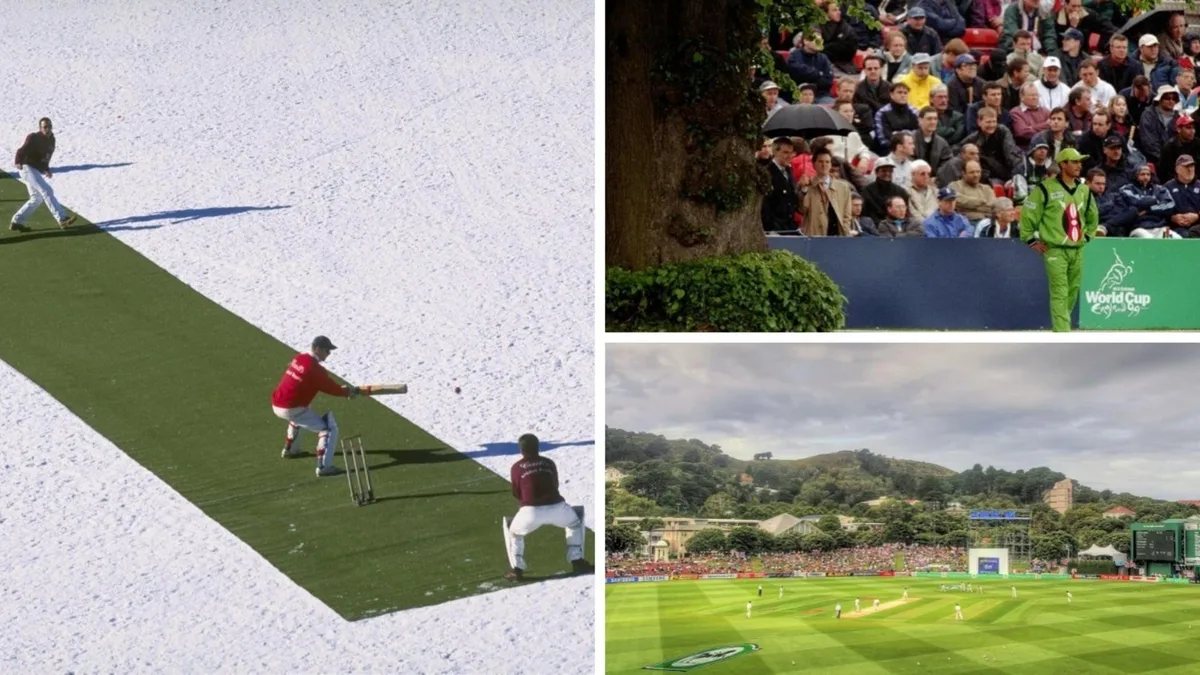
Four international venues have trees inside the boundary lines, which is probably two or three too many for a serious sport. Of these, St Lawrence Cricket Ground (Canterbury) and VRA Cricket Ground (Amstelveen) hosted World Cup matches in 1999, as did the City Oval (Pietermaritzburg) in 2003. The Mombasa Cricket Ground has not done that, but its mango tree is quite substantial.
Olympics at a velodrome
Some of you may know that Great Britain beat France the only time cricket was played in the Olympics, in 1900, to win the gold medal. But few would be aware about that match’s venue … the Velodrome de Viencennes, designed to host cycling. Multipurpose stadia have hosted cricket over the years, but cycling has seldom been “the other sport” in these.
A home in a hippodrome
In Cricket on the Continent, Tim Brooks tells the story of the rise of Estonian cricket at the turn of the millennium, which began with employees of an Indian restaurant (that also included Russians, Ukrainians, and Georgians). Estonian cricket found a home at a football ground and then to the Hippodrome, a racecourse known for “a slightly less golden version of Ben Hur style chariot racing”. It hosts international matches, and remains central to Estonian cricket.
The earthquake-born ground
The 1840 plans for the city of Wellington featured a stream connecting the harbour to a lagoon. But the 8.2-magnitude earthquake of 1855 not only reshaped the city’s shoreline but also elevated the land by 1.5 metres. The “basin” now rose to become a “swamp”. From 1863, prisoners from nearby Mt Cook were employed to drain the swamp and flatten the land, and from that the famous Basin Reserve was born. As recently as in 1871 there were complaints about “unsightly swampy wilderness, choked with thistles and rubbish”, but these were sorted out over time.
The Jersey potato farm
Founded in 1977, the Farmers Cricket Club on the small English island of Jersey lacked its own facilities for a long time until in 2003, when James Perchard sought permission to convert his potato farm to a cricket field. It took 18 months to raze the crops and grow the grass but once it happened, Geoff Boycott and Mike Gatting inaugurated it. It has also hosted international cricket.
Cricket served cold … on ice
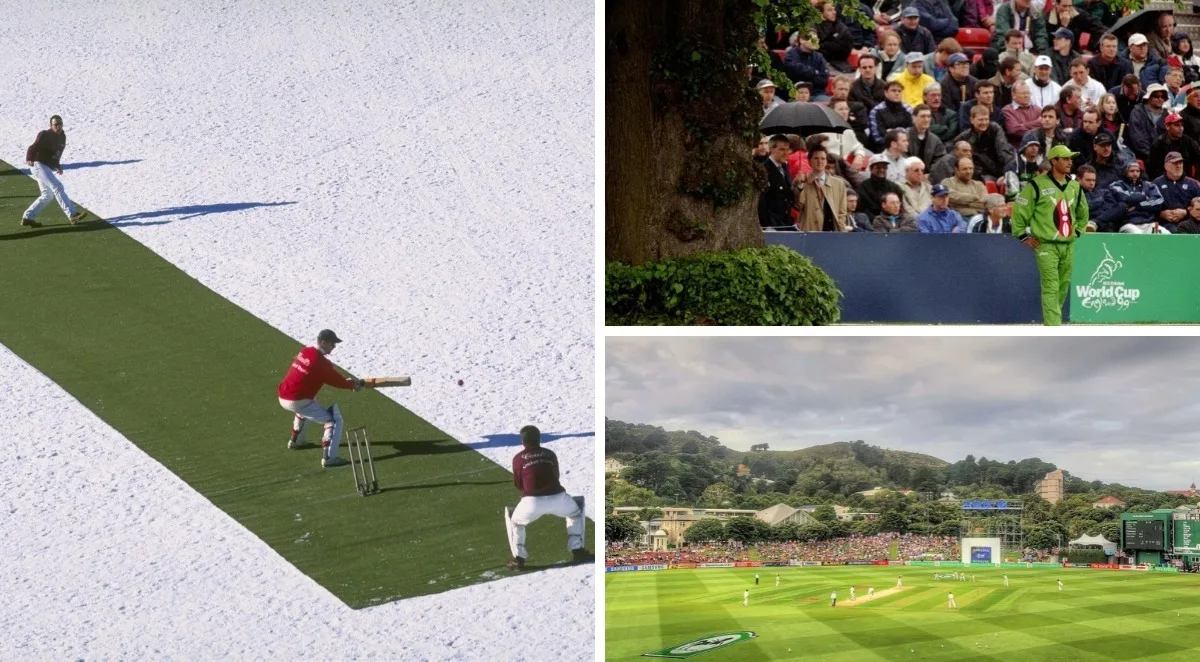
Cricket has been played on ice since at least the first half of the 19th century. Tournaments are played in several European countries (including Estonia and the Netherlands), but the most famous of these is played at St Moritz in Switzerland. Established in 1988, it has featured superstars like Jacques Kallis, Virender Sehwag, Shahid Afridi, Andrew Symonds, and Daniel Vettori.
India-Pakistan on black lava
India’s long-awaited tour of Pakistan in 2004 coincided with a cricket match between members of a peacekeeping mission from the same two nations … in Goma, eastern Congo. The 2002 eruption of Mount Nyiragongo had turned the outfield black, UN soldiers from non-cricketing nations kept walking behind the umpire’s arm, and a herd of goats invaded the field. Yet, as David Turner wrote to the Wisden Almanack in 2005, the match was “as intensely contested as if it were in Karachi or Kolkata”.
Snatching one from football
When the Antwerp Cricket Club lost its ground in Brunst around the turn of the millennium, the club invited the city’s sports minister and vice-mayor to Lord’s to watch a Test match. This made the Belgian politician enough of a cricket convert (naturally) to authorise the handover of an existing football facility to the cricket federation. They gained four grounds, practice facilities, and office space.
Going where Coca-Cola hasn’t
In 2008, two cricket teams from Shanghai visited a nearby nation. Named (with some tact) as “Reunification” and “Juche”, after Kim-Il Sung’s political thesis, they played a triangular T20 tournament with the Pyongyang Cricket Club, “specially formed for the occasion”. Once the sports ministry granted permission (a triumph in itself), the matting wicket was unfurled “with great ceremony” in the backdrop of the Tsaesongsan Fortress, a “large and impressive pagoda-style structure dating back to the third century”. The fortress served as the pavilion. Oh, and the on-field entertainment during a tea interval included a Korean accordion band.
Cement and carpet in Aitutaki
In 2007, six years after he had last played for New Zealand, Grant Bradburn was busy with the trials of the Cook Islands cricket team in Aitutaki where the pitch was “one of seven concrete pits on the island which are sunk below the surface”. These are covered with sand in the winter to host rugby and football, and only after the sand is cleared can the islands have a proper cricket surface. That year, it became obvious that the Tautu strip needed “overnight repairs” by the locals. The use of a flip-flop (and not a trowel) to screed the concrete made things very difficult for the batters, but the match got underway on a pitch covered with a carpet.
Wedding stops cricket on ash
Located in the Atlantic Ocean about 1,500km from Africa and 2,300km from South America, the Ascension Islands are among cricket’s remotest hosts. They also have one of the more unusual venues, with the Church of St Mary the Virgin inside the ground. Canon Nicholas Turner, the Vicar of Ascension, wrote about a wedding stopping a cricket match that could only resume 40 minutes later, once “the last of the congregation left for the reception”. It does not end there: the ground is of rolled volcanic ash, devoid of grass, which makes the outfield very fast. Naturally, they have to use composite balls: traditional leather ones would not last on that surface (or simply land on the church roof).
Lunar lunacy
The Outer Space Treaty of 1967 barred any national government from owning property on “The Moon and Other Celestial Bodies”, but had no restrictions on individuals or organisations. In 2007, thus, dreamcricket.com paid $25 to buy land on the Moon and registered the Dreamcricket Lunar Cricket Field with the Lunar Registry with ambitions of hosting cricket. What happened to that plan? We do not know.